19th May 2026 | By Admin
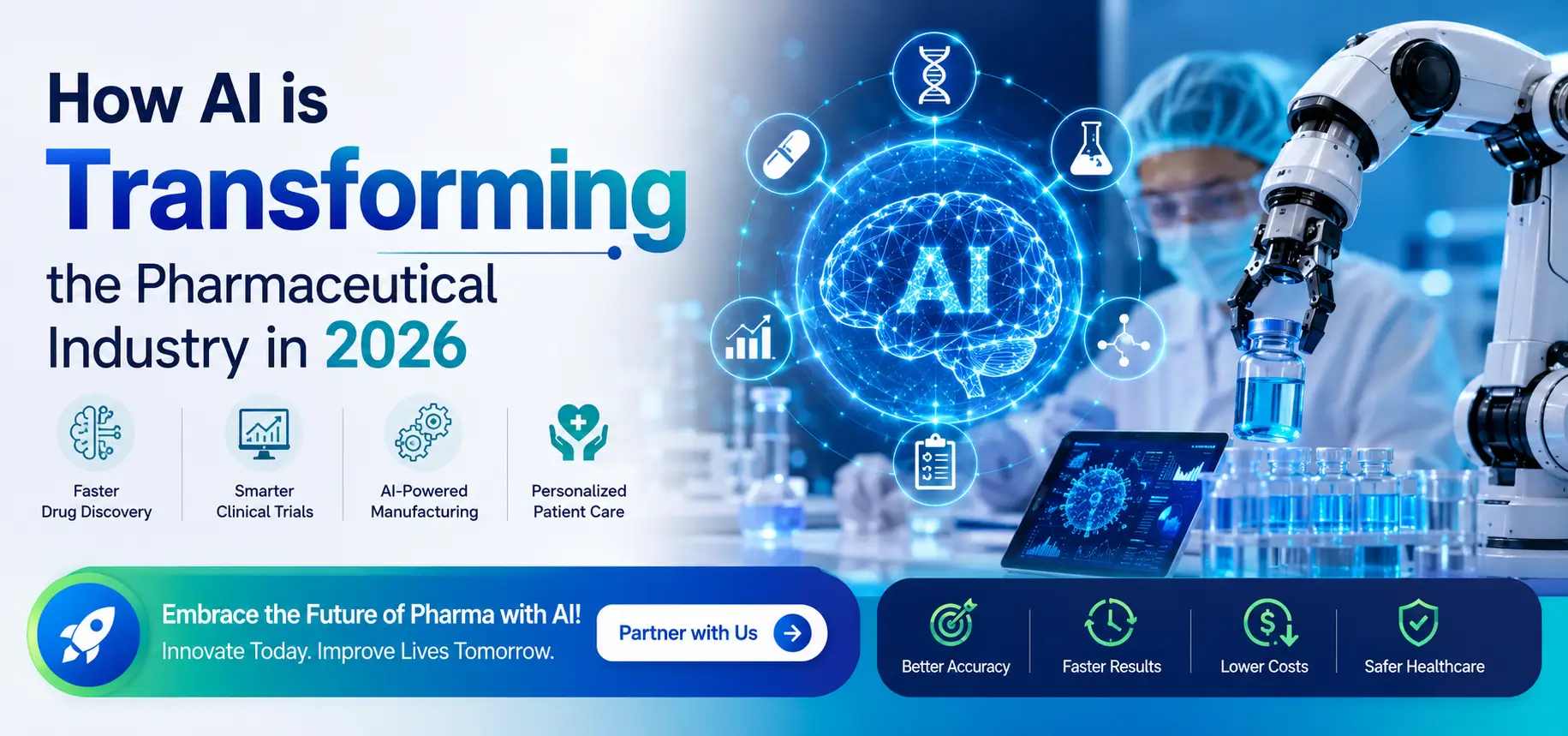
The pharmaceutical industry is entering one of the most transformative periods in its history. In 2026, Artificial Intelligence (AI) is no longer viewed as an experimental technology reserved for innovation labs; it has become a core driver of drug discovery, patient care, pharmaceutical manufacturing, and clinical research.
For years, pharma companies struggled with rising research costs, delayed drug approvals, failed clinical trials, and increasing pressure to deliver personalized treatments. Traditional methods that once powered the industry are now being replaced by intelligent systems capable of analyzing massive datasets within seconds.
Today, AI in the pharmaceutical industry is changing the way medicines are developed, tested, manufactured, and delivered to patients worldwide.
From AI-powered drug discovery to predictive analytics in clinical trials, pharmaceutical companies are using advanced technologies to improve efficiency, reduce costs, and accelerate innovation. The rise of Generative AI in pharma has also opened new possibilities for research automation, medical documentation, and personalized medicine.
As the healthcare sector evolves, businesses looking to expand in the pharma industry are also exploring new growth opportunities through services such as Third Party Manufacturing, PCD Franchise Services, and strategic collaborations with trusted pharmaceutical companies, such as Monark Biocare.
In this article, we’ll explore how AI is transforming the pharmaceutical industry in 2026, the latest innovations shaping the future of healthcare, and why AI-driven pharma companies are leading the next wave of medical advancement.
What is AI in the Pharmaceutical Industry?
Artificial Intelligence in healthcare refers to the use of machine learning, deep learning, natural language processing (NLP), and predictive analytics to improve pharmaceutical processes and healthcare outcomes.
In simple terms, AI enables pharmaceutical companies to analyze huge volumes of medical and scientific data faster and more accurately than humans. This helps researchers identify new drug compounds, predict treatment effectiveness, optimize manufacturing, and improve patient care.
The pharmaceutical industry generates enormous amounts of data every day. Clinical trials, patient records, laboratory research, genomic studies, and manufacturing operations all contribute to this data explosion. AI systems help transform this raw information into actionable insights.
Today, pharma companies are using AI for:
-
Drug discovery and development
-
Clinical trial optimization
-
Personalized medicine
-
Predictive healthcare analytics
-
Pharmaceutical manufacturing automation
-
Regulatory compliance
-
Patient monitoring systems
As digital transformation in pharma accelerates, AI is becoming a competitive necessity rather than an optional technology.
How AI is Revolutionizing Drug Discovery
One of the biggest breakthroughs in the pharmaceutical industry is AI-powered drug discovery.
Traditionally, developing a new medicine could take over 10 years and cost billions of dollars. Researchers had to manually test thousands of chemical compounds before identifying a potential treatment candidate. Even after years of development, many drugs failed during clinical trials.
AI is dramatically changing this process.
Machine learning algorithms can now analyze biological data, chemical structures, and disease patterns to identify promising drug candidates much faster than traditional research methods.
Faster Molecule Identification
The pharmaceutical industry is increasingly using Artificial Intelligence to accelerate molecular research and improve drug discovery accuracy. Advanced AI systems can process complex biological datasets faster than traditional research methods.
-
AI-powered algorithms can screen millions of molecular structures within hours.
-
Researchers can identify promising treatment compounds with greater precision.
-
Predictive AI models help reduce dependency on manual trial-and-error processes.
-
Faster molecule analysis significantly shortens early-stage drug development timelines.
-
Pharmaceutical companies can improve research productivity while lowering operational risks.
By improving speed and accuracy, AI-driven molecule identification is helping pharmaceutical companies develop innovative medicines more efficiently while reducing research delays and development costs.
Drug Repurposing with AI
Modern pharmaceutical companies are using AI-based drug repurposing to discover new therapeutic applications for existing medicines. This innovative approach reduces development time and accelerates treatment availability worldwide.
-
AI analyzes clinical databases, molecular interactions, and patient response patterns.
-
Existing medicines can be evaluated for treating different diseases effectively.
-
Drug repurposing helps reduce lengthy pharmaceutical approval timelines.
-
AI-driven insights improve treatment discovery during healthcare emergencies.
-
Pharmaceutical researchers can identify safer and cost-effective treatment options.
With faster analysis and improved prediction capabilities, AI-powered drug repurposing is transforming pharmaceutical innovation and creating new opportunities for rapid healthcare advancements.
Reduced Research Costs
Rising pharmaceutical research expenses have pushed companies toward AI-driven automation and predictive analytics. Artificial Intelligence helps streamline operations while improving efficiency across pharmaceutical research and development processes.
-
AI automates repetitive research and laboratory tasks efficiently.
-
Predictive analytics reduces failed drug experiments and testing costs.
-
Pharmaceutical companies can optimize resource allocation and research planning.
-
Faster data analysis minimizes operational delays in drug development.
-
AI improves decision-making by identifying high-potential drug candidates earlier.
By lowering operational costs and improving research accuracy, Artificial Intelligence in pharma is helping companies accelerate innovation while maintaining long-term financial sustainability.
Many businesses entering the pharmaceutical market are now combining AI-driven research with scalable operational models such as third-party manufacturing to improve production efficiency and market reach.
AI in Clinical Trials and Patient Data Management
Clinical trials are essential for ensuring the safety and effectiveness, but they are also time-consuming and expensive.
A large percentage of clinical trials fail because of poor patient recruitment, inaccurate data collection, or delayed reporting.
AI in clinical trials is helping solve these challenges.
Smarter Patient Recruitment
Finding eligible participants is one of the most difficult parts of clinical research.
AI systems can analyze patient records, medical histories, and demographic information to identify suitable candidates more efficiently.
This improves recruitment speed and increases trial accuracy.
Real-Time Data Monitoring
AI-powered systems can continuously monitor clinical trial data in real time.
Researchers can quickly identify safety concerns, detect anomalies, and make informed decisions without waiting for manual reporting processes.
This improves both patient safety and operational efficiency.
Predictive Analytics for Better Outcomes
Predictive healthcare analytics enables pharmaceutical companies to forecast patient responses and trial outcomes using historical data patterns.
This reduces the likelihood of failed trials and improves drug approval success rates.
The growing role of AI in healthcare is also creating new business opportunities for entrepreneurs interested in start your business models within the pharma sector.
Generative AI and Pharma Automation in 2026
Generative AI is becoming one of the most influential technologies in the pharmaceutical industry.
Unlike traditional AI systems that focus mainly on analysis, Generative AI can create content, generate reports, summarize research findings, and automate complex workflows.
In 2026, pharma companies are using Generative AI in pharma for:
-
Medical documentation
-
Research summarization
-
Drug formulation analysis
-
Regulatory compliance reports
-
AI-assisted scientific writing
-
Customer support automation
AI in Pharmaceutical Manufacturing
AI-powered automation is helping manufacturers improve production quality and reduce operational errors.
Smart manufacturing systems can monitor equipment performance, predict maintenance requirements, and optimize production workflows.
This is particularly valuable in high-demand healthcare sectors such as Injectable Medicines & Critical Care, where precision and quality control are essential.
AI also helps pharmaceutical companies maintain regulatory standards while reducing waste and production downtime.
AI for Regulatory Compliance
Regulatory compliance is one of the most complex areas of pharmaceutical operations.
AI tools can automatically review documentation, identify inconsistencies, and ensure compliance with healthcare regulations.
This reduces manual workload and improves operational accuracy.
Companies like Monark Criticare are increasingly focusing on innovation-driven healthcare solutions to meet the growing demand for advanced critical care medicines.
AI and Personalized Medicine
One of the most exciting developments in modern healthcare is Personalized Medicine.
Traditional treatments are often designed for large populations, but every patient responds differently to medication based on genetics, lifestyle, and medical history.
AI enables healthcare providers to create personalized treatment plans tailored to individual patients.
By analyzing genomic data, medical records, and patient behavior, AI systems can recommend highly targeted therapies that improve treatment outcomes.
AI-Powered Diagnostics
AI-driven diagnostic tools can detect diseases earlier and more accurately than traditional methods.
These systems are already being used in areas such as:
-
Cancer detection
-
Cardiovascular disease analysis
-
Neurological disorder diagnosis
-
Radiology imaging
-
Predictive risk assessment
Early diagnosis allows healthcare professionals to provide faster and more effective treatment.
Top Benefits of AI in the Pharmaceutical Industry
|
AI Application |
Key Benefit |
|
Drug Discovery |
Faster molecule identification |
|
Clinical Trials |
Better patient recruitment |
|
Manufacturing |
Reduced operational costs |
|
Predictive Analytics |
Improved decision-making |
|
Personalized Medicine |
Better treatment outcomes |
|
Regulatory Compliance |
Faster documentation processing |
|
Diagnostics |
Early disease detection |
How is AI Used in the Pharmaceutical Industry?
AI is used in the pharmaceutical industry to improve drug discovery, optimize clinical trials, automate manufacturing, enhance diagnostics, and support personalized medicine. Pharmaceutical companies use machine learning and predictive analytics to reduce research costs, improve efficiency, and accelerate healthcare innovation.
Challenges of AI Adoption in Pharma
Although Artificial Intelligence in pharma offers significant advantages, many pharmaceutical companies still face operational, technical, and regulatory challenges while implementing AI-driven systems across healthcare and research environments.
-
Data Privacy Concerns: Healthcare data is highly sensitive. Pharmaceutical companies must ensure patient privacy and cybersecurity protection.
-
High Implementation Costs: Advanced AI infrastructure requires significant investment, especially for smaller organizations.
-
Regulatory Complexity: AI-based healthcare systems must comply with strict government regulations and ethical standards.
-
Skilled Workforce Shortage: The industry needs professionals with expertise in both healthcare and artificial intelligence.
However, despite these challenges, the long-term benefits of AI significantly outweigh the obstacles.
Future Trends of AI in Pharmaceuticals
The future of AI in pharmaceuticals is rapidly evolving as healthcare companies adopt intelligent technologies to improve drug discovery, personalized medicine, manufacturing efficiency, and patient care outcomes.
Emerging innovations such as predictive analytics, AI-powered diagnostics, robotics, and automated research laboratories are expected to redefine the future of healthcare and pharmaceutical advancement globally.
-
Autonomous Research Labs: AI-powered laboratories may soon automate entire pharmaceutical research processes with minimal human intervention, improving efficiency, accelerating drug discovery, and reducing manual research workload significantly.
-
Digital Twins in Healthcare: Researchers are developing virtual patient models that simulate treatment outcomes before real-world testing, helping pharmaceutical companies improve clinical trial accuracy and personalized treatment planning.
-
AI-Powered Precision Medicine: Personalized healthcare will continue expanding as AI systems become more accurate and data-driven, enabling doctors to create customized treatments based on patient genetics and medical history.
-
Robotics and Smart Manufacturing: AI-integrated robotics will improve pharmaceutical manufacturing efficiency, reduce operational errors, maintain product quality standards, and optimize large-scale medicine production processes.
-
AI-Driven Predictive Diagnostics: Advanced AI diagnostic systems will help healthcare providers detect diseases earlier through predictive analysis, improving patient outcomes and supporting faster medical decision-making across healthcare facilities.
-
Natural Language Processing in Healthcare: AI-powered NLP technologies will streamline medical documentation, automate research analysis, and improve communication between healthcare professionals, researchers, and pharmaceutical organizations.
-
Blockchain and AI Integration: The combination of blockchain technology and AI may improve pharmaceutical supply chain transparency, enhance drug traceability, and strengthen healthcare data security systems worldwide.
As the industry grows, pharma entrepreneurs are increasingly exploring opportunities through monopoly PCD pharma business models and partnerships with trusted healthcare brands.
Businesses seeking long-term growth are also turning toward the Best Medicine Pharma Franchise opportunities to strengthen market presence in competitive healthcare sectors.
Real-World Impact of AI in Pharma
AI is already delivering measurable results across the pharmaceutical ecosystem.
Leading healthcare companies are using machine learning to reduce drug development timelines, improve manufacturing precision, and optimize patient outcomes.
From biotech startups to global pharmaceutical enterprises, AI adoption is becoming essential for staying competitive in the healthcare industry.
Organizations such as Monark Biocare are positioned to benefit from this digital transformation by integrating innovation, operational efficiency, and advanced healthcare solutions into modern pharmaceutical practices.
Conclusion
Artificial Intelligence is reshaping the pharmaceutical industry faster than ever before. In 2026, AI is no longer just a technological trend; it has become a strategic necessity for pharmaceutical companies seeking innovation, efficiency, and long-term growth.
From AI-powered drug discovery and predictive analytics to personalized medicine and smart manufacturing, the impact of AI in pharma is transforming every stage of the healthcare ecosystem.
As the industry evolves, businesses that embrace digital transformation, advanced automation, and intelligent healthcare solutions will lead the future of medicine.
Whether through innovative research, scalable PCD Franchise Services, or strategic pharmaceutical partnerships, the next generation of healthcare companies will be defined by how effectively they integrate AI into their operations.
The future of pharma is intelligent, data-driven, and deeply connected to Artificial Intelligence, and this transformation has only just begun.
Frequently Asked Questions
1. How is AI transforming the pharmaceutical industry?
AI is transforming the pharmaceutical industry by accelerating drug discovery, improving clinical trial efficiency, enabling personalized medicine, and automating pharmaceutical manufacturing processes.
2. What are the benefits of AI in pharma?
The major benefits include faster research, reduced development costs, improved patient outcomes, predictive analytics, and better healthcare automation.
3. What is Generative AI in pharmaceuticals?
Generative AI in pharmaceuticals refers to AI systems capable of creating reports, summarizing research, generating medical content, and supporting drug development processes.
4. Can AI replace pharmaceutical researchers?
AI is unlikely to replace researchers entirely. Instead, it acts as a powerful tool that enhances human expertise, improves productivity, and supports better decision-making.
5. What is the future of AI in healthcare?
The future of AI in healthcare includes personalized medicine, autonomous research labs, predictive diagnostics, robotics, and AI-driven healthcare ecosystems.