
11th July 2026 | By Admin
Every year, thousands of medical representatives, distributors, and first-time entrepreneurs across India ask the same question before they take the leap: how much profit can you actually earn from a pharma franchise business?
It's a fair question. Starting any business means putting your savings on the line, and the pharmaceutical sector — while promising — is often surrounded by inflated claims and vague answers. Some advertisements promise unrealistic returns "in just 3 months". Others stay silent about the real numbers altogether.
This guide cuts through the noise. We'll walk you through actual profit margins, the investment required to start a PCD Pharma franchise, how monopoly rights affect your income, and the mistakes that quietly eat into new franchise owners' earnings. Whether you're a medical representative planning to go independent, a distributor exploring a new revenue stream, or an entrepreneur evaluating the pharma franchise business for the first time, this article gives you a grounded, practical picture.
What Is a PCD Pharma Franchise?
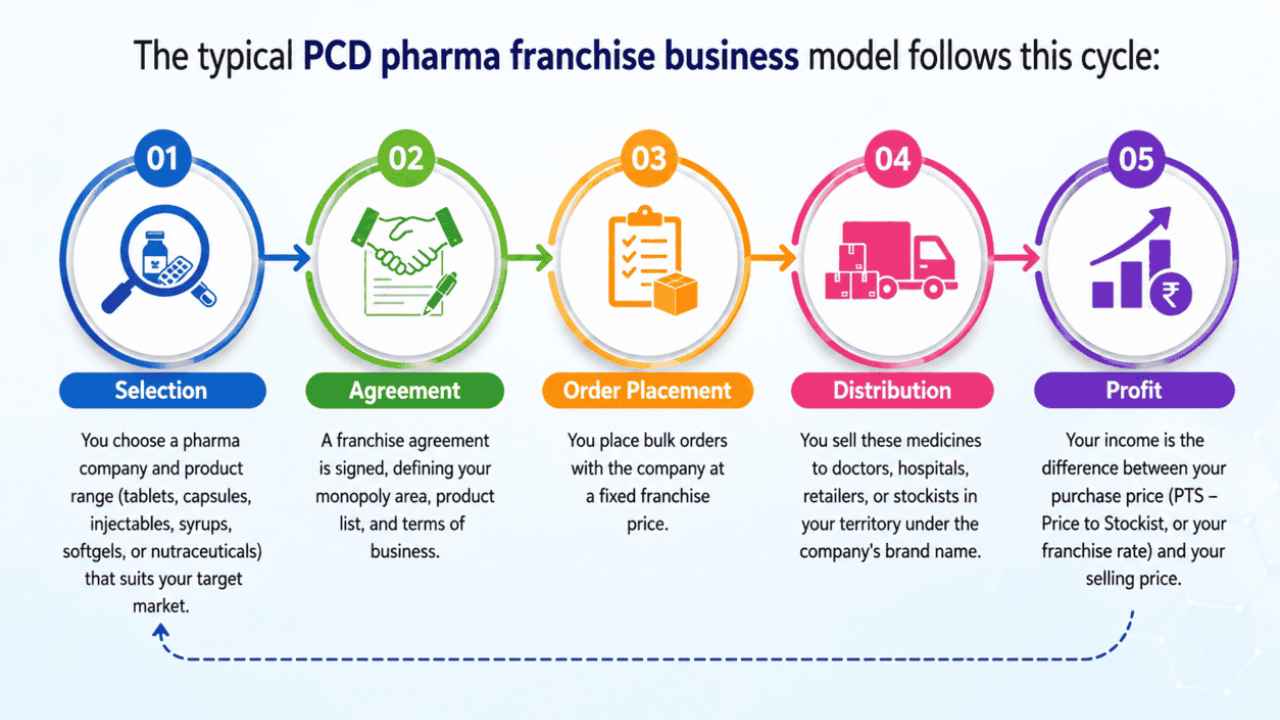
A PCD Pharma Franchise is a business arrangement where a pharmaceutical company grants an individual or firm the rights to market and distribute its medicines within a specific area, using the company's brand name, product range, and promotional materials, typically with monopoly rights and low investment.
PCD stands for Propaganda Cum Distribution. Under this model, a pharmaceutical company (like Monark Biocare) manufactures WHO-GMP-certified medicines, and the franchise partner sells and promotes these products in a defined territory. The franchise holder doesn't need a factory, a large team, or years of pharma experience, just the right approach to sales and distribution.
This differs from opening your own manufacturing unit. Instead, you leverage an established company's product portfolio, quality certifications, and marketing materials, while earning margins on every sale.
What Are Typical Profit Margins in a PCD Pharma Franchise Business?
Pharma franchise profit margins are not fixed. They vary by product category, business scale, and partner activity level. Studies indicate margins can reach as high as 30% on the lower end and up to 50% for well-managed franchises with high-demand product ranges and monopoly rights
The basic formula for calculating your profit margin is:
Profit Margin (%) = (Net Profit ÷ Revenue) × 100
Where Net Profit is revenue minus all operating costs, and Revenue is total income from product sales.
Margin Ranges by Product Type Generic medicines: 20%–35% margins Branded formulations: 30%–50% margins Nutraceuticals and wellness products: 40%–60% margins Specialty segments (gynecology, neurology, dermatology): 35%–55% margins These ranges are indicative. Actual margins depend on the pricing structure set by the pharma company, operating expenses, and local market demand.
Because you're not paying for R&D, regulatory approvals, or manufacturing infrastructure, your primary running costs are working capital, local marketing, and logistics — which is why margins in this model tend to be healthier than in many other small businesses.
Investment Required to Start a Pharma Franchise
Starting a PCD pharma franchise typically requires an investment of ₹50,000 to ₹5 lakh, depending on the company, product range, and order size. This usually covers initial stock purchase, registration, and promotional inputs, making it one of the lower-cost business models in the healthcare sector.
Here's a rough breakdown of where your initial capital typically goes:
| Initial product order (stock) | ₹30,000 – ₹3,00,000 |
| Drug license & registration (if not already held) | ₹5,000 – ₹15,000 |
| Promotional inputs (visual aids, MR bags, sample kits) | ₹5,000 – ₹20,000 |
| GST registration | Minimal / one-time |
| Miscellaneous (travel, local marketing) | Miscellaneous (travel, local marketing) |
Many companies, including Monark Biocare, offer flexible entry points so that medical representatives with limited capital can still get started, while larger distributors can negotiate bigger monopoly territories with higher initial stock commitments.
Profit Margins: The Real Numbers
Profit margins in a PCD pharma franchise generally range between 20% and 30% on maximum retail price (MRP) for franchise partners, though margins can vary by product category – injectables and speciality formulations often carry higher margins than basic tablets and syrups.
This is the section most people skip straight to, so let's be direct and realistic about it.
Typical Margin Ranges by Product Category
| Product Category | Approximate Margin for Franchise Partner |
| Tablets & Capsules | 20% – 25% on MRP |
| Syrups & Dry Syrups | 20% – 25% on MRP |
| Injectables | 25% – 35% on MRP |
| Softgel Capsules | 22% – 28% on MRP |
| Ayurvedic & Nutraceutical Products | 25% – 30% on MRP |
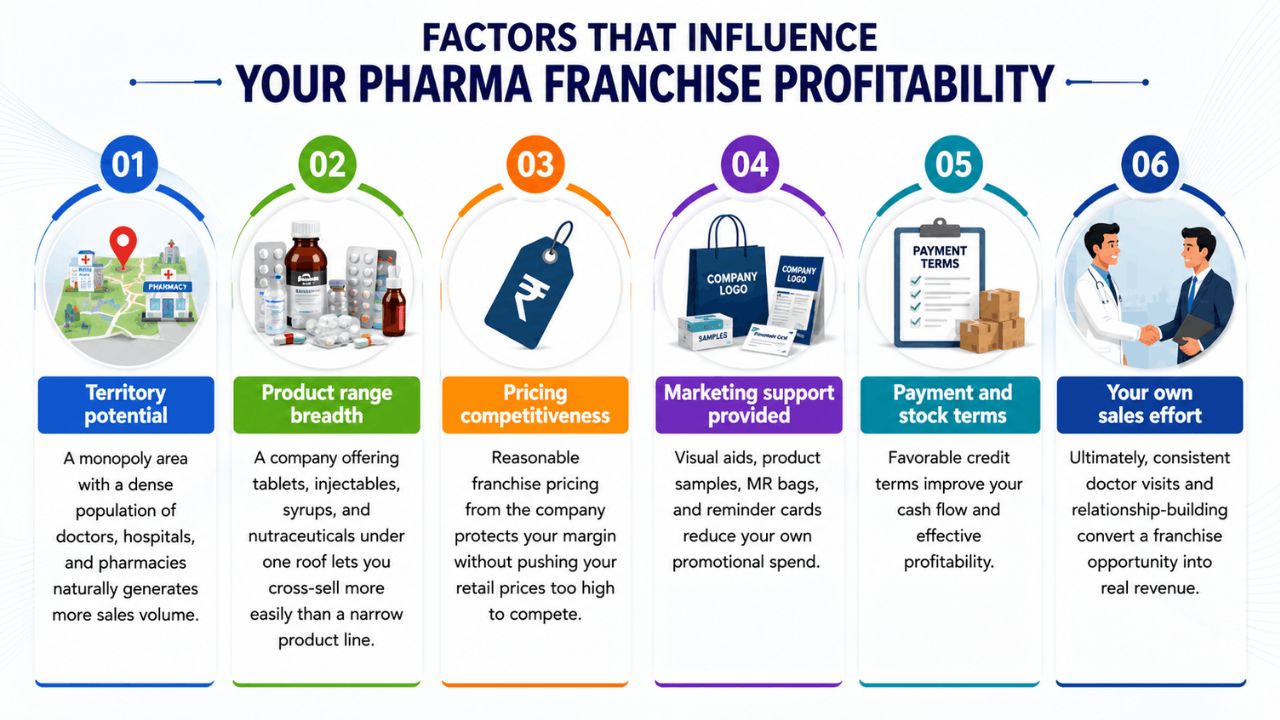
These figures are indicative and can shift based on the manufacturer's pricing policy, your negotiated rates, and the competitive intensity in your territory. A well-run franchise, selling consistently across a defined monopoly area, can realistically expect monthly turnovers ranging from modest side-income levels to substantial full-time earnings once the customer base (doctors, chemists, and stockists) is established – usually over a 6 to 18 month period, not overnight.
It's worth noting: profit margin is not the same as net profit. Your actual take-home profit is this margin minus your operating costs — travel, salaries (if you hire field staff), promotional expenses, and unsold or expired stock.
Monopoly Rights and Their Impact on Earnings
A monopoly pharma franchise grants you exclusive rights to sell a company's products within a defined district, city, or state — meaning the company will not appoint another franchise partner in that same territory for the same products.
This directly protects your profit because:
- You don't compete against another franchise holder selling the identical brand.
- You can build long-term relationships with doctors without a rival undercutting your prices.
- It allows predictable planning of stock, staffing, and promotional investment.
Without monopoly protection, multiple franchise holders in the same area can end up competing on price, which erodes margins for everyone. This is why experienced distributors and medical representatives specifically look for monopoly pharma franchise opportunities before signing an agreement.
Documents and Eligibility Required
To start a PCD pharma franchise, you typically need:
- A valid Drug License (wholesale or retail, depending on your role)
- GST registration
- Aadhaar and PAN card for identity verification
- Business address proof (shop, office, or godown)
- In some cases, a Udyam/MSME registration for added credibility
Eligibility is fairly open — pharma companies typically welcome medical representatives, distributors, wholesalers, retired pharma professionals, and even non-pharma entrepreneurs with an interest in healthcare business, provided the necessary licenses are in place.
Common Mistakes That Reduce Pharma Franchise Profitability
Several avoidable errors consistently reduce earnings in this business:
Choosing a company based on price alone. Low-cost products from uncertified manufacturers damage credibility with doctors and lead to returns and complaints. Ignoring marketing support tools. Partners who rely solely on product availability without actively promoting to doctors grow slowly. Operating without monopoly rights. Shared territories lead to price undercutting and customer poaching, which compress margins. Neglecting chemist relationships. Chemists influence prescription fulfillment. Poor chemist relationships result in product substitutions and lost sales. Overextending product range too early. Stocking too many products before building a customer base ties up capital and complicates inventory management. Inconsistent follow-up with doctors. Prescription volumes decline when doctors are not regularly engaged. Consistency in doctor visits is essential for sustained income.
WHO-GMP Certification and Why It Matters for Profitability
Choosing a WHO-GMP certified pharma company isn't just a compliance checkbox — it directly protects your profit. Here's how:
- Fewer product returns – Quality-consistent medicines mean fewer complaints and returns from doctors and pharmacies.
- Doctor trust – Physicians are more willing to prescribe products backed by proper DCGI approvals and GMP manufacturing, leading to repeat business.
- Regulatory safety – Selling non-compliant products can lead to legal complications that damage your business and finances.
- Long-term brand credibility – A WHO-GMP and ISO-certified partner builds a reputation you can rely on for years, rather than a short-term opportunity that collapses after quality issues emerge.
At Monark Biocare, our WHO-GMP-certified manufacturing standards are built specifically to protect the long-term profitability and reputation of our franchise partners.
Future of the Pharma Franchise Business in India
India's pharmaceutical market continues to expand, driven by rising healthcare awareness, growing chronic disease treatment needs, and increasing rural healthcare penetration. The PCD pharma franchise model is expected to remain a strong entry point for new entrepreneurs because it combines low investment with the backing of established, regulation-compliant manufacturers.
Government initiatives supporting third-party pharma manufacturing, along with steady demand for ethical pharma and generic medicines, suggest continued opportunity for franchise partners who align with quality-focused companies rather than the lowest-price option in the market.
Explore PCD Pharma Franchise Opportunities with Monark Biocare
Monark Biocare is an ISO certified, WHO-GMP, and GLP certified pharma company based in Haryana, India. With 15+ years of experience, 2,000+ DCGI-approved pharma products, 5+ specialized divisions, and 2,200+ satisfied franchise partners across India, Monark Biocare provides PCD Pharma Franchise opportunities with monopoly rights, complete marketing support, and timely delivery.
The product portfolio spans tablets, capsules, softgels, syrups, dry syrups, injections, ointments, eye/ear/nasal drops, sachets, dental care, and respules — covering 17+ therapy areas, including gynaecology, neurology, orthopaedics, cardiology, dermatology, and nutraceuticals.
Contact Monark Biocare to explore franchise opportunities: 📞 +91-9855986633 📧 monarkbiocare@gmail.com 📍 Plot No. 201, HSIIDC, Alipur, Barwala, Haryana, India
Frequently Asked Questions
A PCD Pharma Franchise is a business model where a pharma company grants marketing and distribution rights for its products to an individual or firm within a specific territory, usually with monopoly rights.
Investment typically ranges from ₹50,000 to ₹5 lakh, depending on the company and product range chosen.
Margins usually range from 20% to 35% depending on the product category, with injectables often offering higher margins than tablets or syrups.
Choose a certified pharma company, verify its product range and monopoly policy, complete the required documentation, and sign a franchise agreement.
Yes, a valid wholesale or retail drug license is generally required to operate legally.
PCD franchise usually offers monopoly rights and brand-specific products, while distribution often involves multiple brands without exclusivity.
It means you get exclusive rights to sell a company's products within a defined territory, without internal competition from other franchise holders of the same brand.
Most franchise partners see steady returns within 6 to 18 months as doctor relationships and territory sales build up.
Typically tablets, capsules, syrups, injectables, softgel capsules, dry syrups, and sometimes nutraceutical or ayurvedic products.
Yes, it ensures manufacturing quality, regulatory compliance, and long-term credibility with doctors and stockists.