12th August 2026 | By Admin
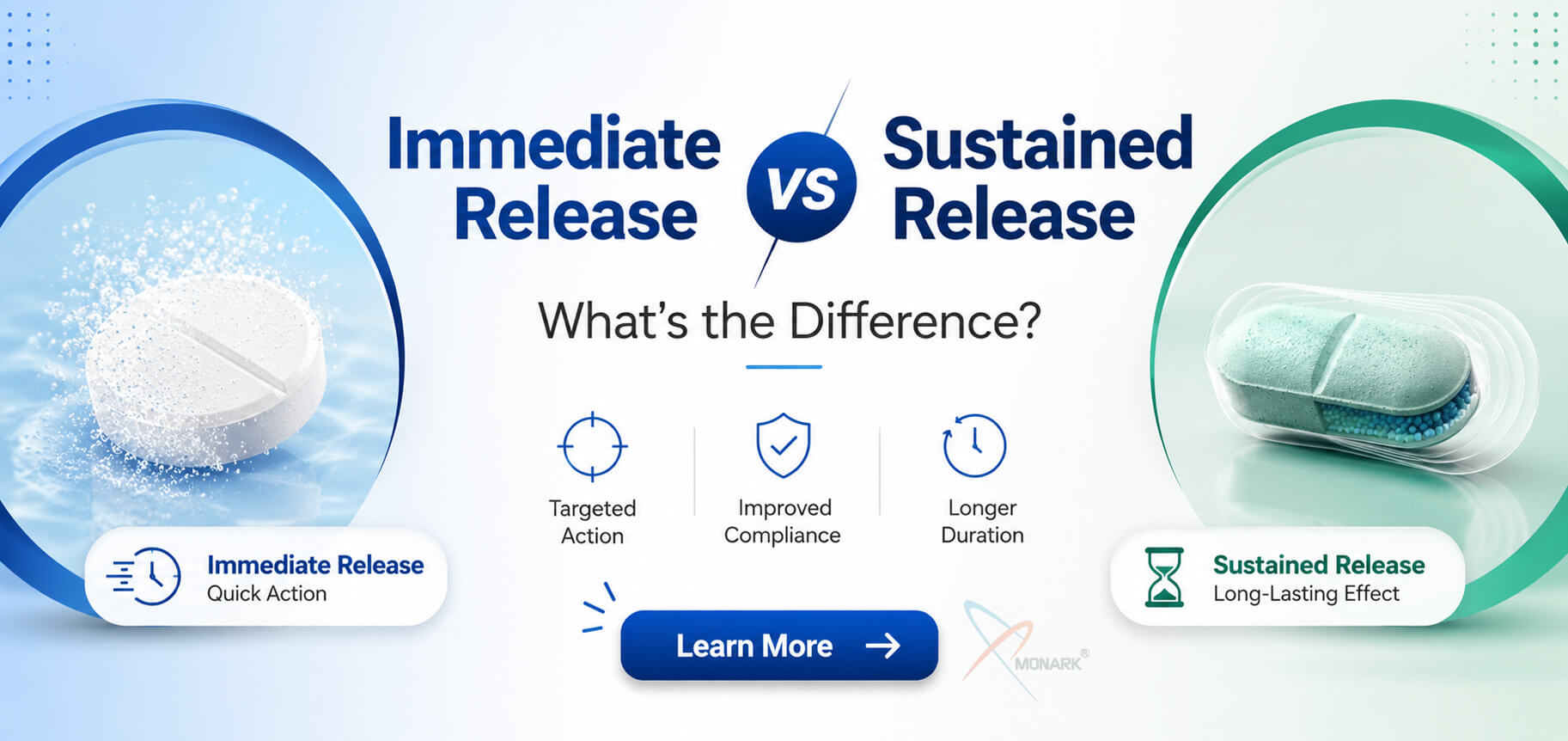
Immediate Release vs Sustained Release Tablets: What’s the Difference?
Two tablets can contain medicine from the same broad category yet behave very differently after you take them. Why? The answer is formulation.
Some tablets are designed to release their active ingredient relatively quickly. Others are engineered to release it gradually over a longer period. That difference can influence the tablet's drug release profile, dosing schedule, formulation technology, and intended use.
So, when comparing Immediate-Release vs. Sustained-Release Tablets, which is better? The more useful question is: why was that particular release profile designed in the first place?
Quick Answer: Immediate Release vs Sustained Release
Immediate-release tablets are generally designed to make their active ingredient available through a conventional, relatively rapid release process. Sustained-release tablets are formulated to release the active ingredient gradually over an extended period. The appropriate formulation depends on the medicine, its characteristics, therapeutic objective, and specific product instructions.
One Tablet, Two Very Different Release Profiles
The word “tablet” describes the dosage form, but it doesn't tell you how the medicine will be released.
Pharmaceutical companies can design tablets with very different release characteristics depending on the active pharmaceutical ingredient (API), therapeutic objective, stability requirements, and desired drug-delivery profile.
This is why understanding different types of tablets is useful. Conventional immediate-release tablets, dispersible tablets, extended-release products, sustained-release formulations, and combination tablets can all serve different purposes.
At the heart of the difference is one question:
How quickly should the active ingredient become available, and for how long should the formulation continue releasing it?
That question influences everything from formulation development to manufacturing and quality testing.
Immediate Release: When the Drug Needs to Become Available Faster
Immediate release tablets are conventional oral dosage forms designed to release the active ingredient without deliberately creating a prolonged-release profile. The term “immediate” does not mean the medicine works instantly. It refers to the intended release characteristics of the dosage form.
Once administered, the tablet typically undergoes disintegration and dissolution before the active ingredient becomes available for absorption.
From Tablet to Drug Availability
The process can be simplified into four stages:
-
Disintegration: The tablet breaks apart.
-
Dissolution: The active ingredient dissolves in gastrointestinal fluids.
-
Drug availability: The dissolved ingredient becomes available for absorption.
-
Absorption: The drug enters systemic circulation according to its properties.
The actual rate at which this occurs depends on the medicine, formulation, solubility, particle characteristics, gastrointestinal conditions, and individual patient factors.
What Makes Immediate Release Different?
An immediate-release formulation generally isn't designed to hold the active ingredient back for an extended period.
Its formulation may be influenced by:
-
Active pharmaceutical ingredient properties
-
Excipients
-
Tablet hardness
-
Particle size
-
Disintegration characteristics
-
Dissolution behavior
-
Manufacturing process
This makes immediate release tablets an important and widely used category of oral dosage forms.
Sustained Release: Designed to Keep Releasing Over Time
Now consider the opposite approach.
Sustained release tablets are designed to release their active ingredient gradually over a longer period rather than following a conventional release profile.
The objective isn't simply to make a tablet last longer. It involves creating a specific sustained release formulation that controls how the active ingredient leaves the dosage form.
Depending on the medicine, formulation scientists may use polymers, matrix systems, coatings, or other release-controlling technologies.
The Slow-and-Steady Release Concept
A simplified sustained release mechanism looks like this:
-
The tablet is administered.
-
Gastrointestinal fluids interact with the formulation.
-
The release-controlling system begins releasing the active ingredient.
-
The drug is released progressively.
-
The formulation follows its intended release profile.
The exact mechanism varies between products.
That is why sustained-release formulation development can require careful evaluation of the API, excipients, manufacturing process, dissolution characteristics, stability, and finished-product performance.
Why Prolonged Release Can Be Useful
For an appropriate medicine, a prolonged drug release profile may offer potential advantages such as:
-
Extended drug release
-
Potentially less frequent administration
-
Greater dosing convenience
-
Controlled delivery of the active ingredient
However, these are formulation objectives, not universal guarantees. A sustained-release product is not automatically better than an immediate-release product.
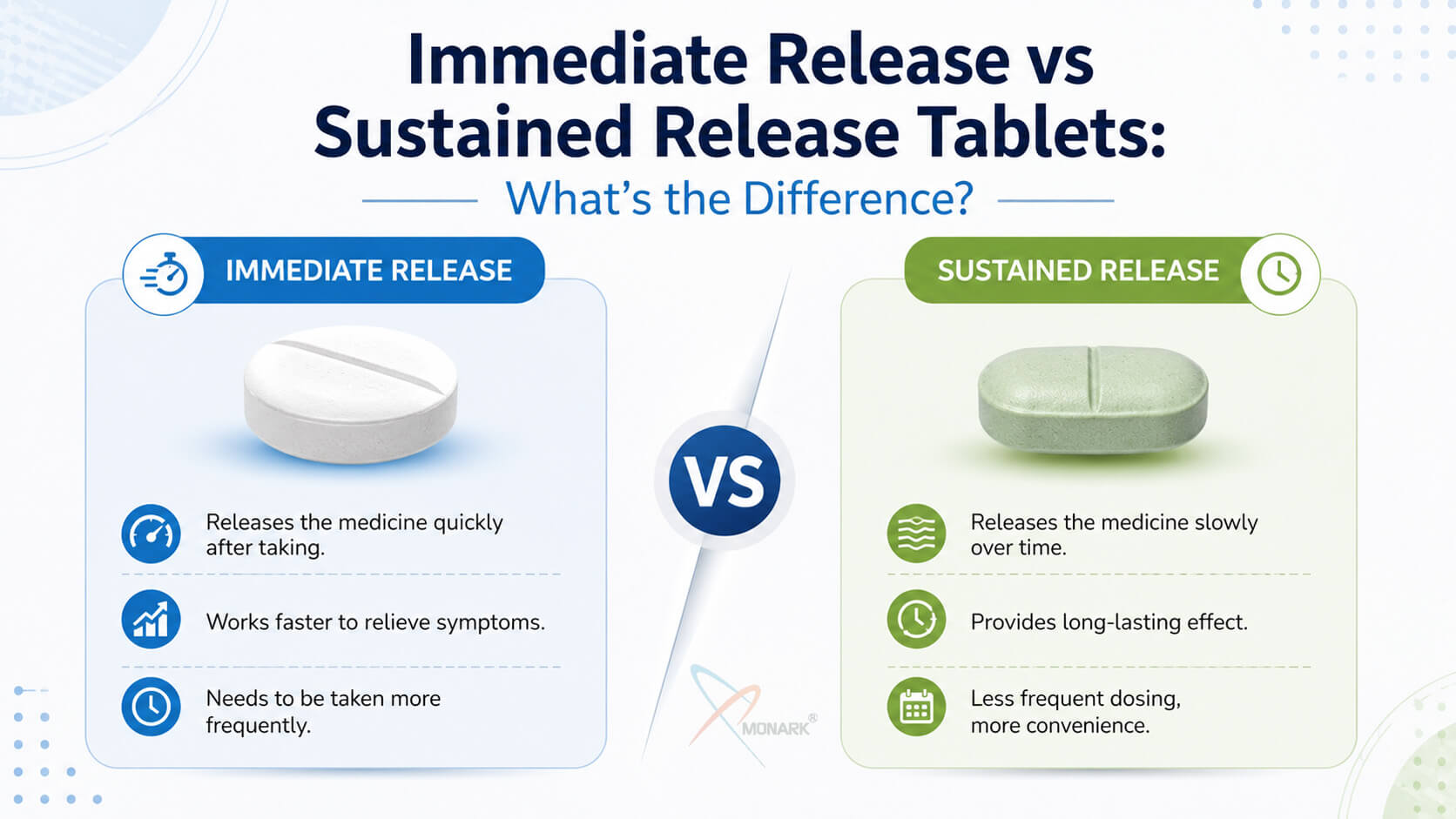
IR vs SR Tablets: The Difference in One Table
The clearest way to understand Immediate Release vs Sustained Release Tablets is to compare their intended release characteristics.
|
Feature |
Immediate-Release Tablets |
Sustained-Release Tablets |
|
Release pattern |
Conventional/relatively rapid release |
Gradual/prolonged release |
|
Primary goal |
Make the drug available through a conventional profile |
Extend drug release over time |
|
Release technology |
Conventional formulation |
Modified-release formulation |
|
Release duration |
Generally shorter |
Designed to continue for longer |
|
Dosing frequency |
Depends on the medicine |
May permit less frequent dosing for suitable products |
|
Formulation complexity |
Often conventional |
May require specialized technology |
|
Drug release profile |
Conventional |
Controlled or prolonged |
|
Patient convenience |
Depends on the prescribed schedule |
May offer convenience in appropriate medicines |
The Main Difference in Simple Terms
Think of it this way:
Immediate release:
The formulation is designed to make the active ingredient available through a conventional release process.
Sustained release:
The formulation is designed to control and extend the release of the active ingredient.
The important distinction is therefore how the formulation delivers the drug, not simply how much drug the tablet contains.
What Actually Happens After You Take the Tablet?
This is where the science behind the formulation becomes easier to understand.
An immediate-release tablet generally disintegrates, allowing the active ingredient to dissolve and become available for absorption.
A sustained-release formulation, in contrast, contains a release-controlling design intended to regulate the movement of the active ingredient out of the dosage form.
A simplified comparison looks like this:
|
Stage |
Immediate Release |
Sustained Release |
|
Administration |
Tablet is taken |
Tablet is taken |
|
Disintegration |
Conventional process |
Depends on formulation |
|
Drug release |
Relatively rapid/conventional |
Gradual/prolonged |
|
Availability |
Drug becomes available according to its properties |
Availability is extended by formulation design |
|
Overall objective |
Conventional drug delivery |
Prolonged drug delivery |
The body still plays a major role in what happens next. Absorption and therapeutic response depend on the active ingredient and many physiological and pharmacokinetic factors.
Why “Sustained,” “Extended,” and “Controlled” Release Cause Confusion
Search for sustained release tablets, and you'll quickly encounter terms such as:
-
Extended release tablets
-
Controlled release tablets
-
Prolonged release tablets
-
Modified release tablets
-
Modified release dosage forms
They all relate to the broader concept of changing a conventional drug-release pattern, but they should not automatically be treated as identical in every technical context.
Sustained Release vs Extended Release
Sustained release generally refers to a formulation designed to prolong the release of the active ingredient.
Extended release likewise describes a formulation intended to extend drug release compared with a conventional immediate-release product.
The exact terminology and release characteristics depend on the individual product, formulation technology, labeling, and applicable regulatory framework.
Where Modified Release Fits In
Modified release tablets represent a broader category in which the release characteristics of a drug have been intentionally altered.
This can include approaches designed to:
-
Prolong release
-
Control release
-
Delay release
-
Change the timing of drug availability
-
Modify the conventional release profile
For that reason, the product's specific information should always take priority over assumptions based only on the name.
Which Release Type Makes More Sense for a Medicine?
There isn't one universal answer.
The right formulation depends on the active ingredient and what the medicine is intended to achieve.
When Immediate Release May Make Sense
A conventional release profile may be appropriate when the medicine's characteristics and therapeutic requirements support it.
Factors can include:
-
Desired drug availability
-
Dose requirements
-
Solubility
-
Pharmacokinetic characteristics
-
Treatment schedule
-
Stability considerations
When Sustained Release May Be Appropriate
A prolonged-release approach may be useful when extended drug availability is desirable for a particular medicine.
Potential formulation goals include:
-
Longer release duration
-
Controlled drug delivery
-
Potentially reduced dosing frequency
-
Greater dosing convenience
So, Which One Is Better?
Neither formulation is automatically “better.”
The better question is:
Which release profile is appropriate for the specific medicine?
A formulation suitable for one active ingredient may be unsuitable for another. Pharmaceutical development therefore considers the properties of the API, intended therapeutic use, release requirements, stability, manufacturing process, and quality specifications.
Real Pharmaceutical Examples: From Nitrofurantoin to Etodolac
Looking at actual pharmaceutical products makes the concept more practical.
Monark Biocare's tablet portfolio includes Nitrofurantoin Sustained Release Tablets, demonstrating the use of sustained-release formulation technology in a pharmaceutical product.
The portfolio also includes Aceclofenac 200mg Sustained Release Tablet, showing another example of a medicine developed with a prolonged-release approach.
For extended-release formulations, Etodolac Extended Release Tablets provide another example of how release technology can be applied to pharmaceutical dosage forms.
The product portfolio also includes Sustained Release Combination Tablets, where multiple active ingredients can be incorporated into a formulation designed around a particular release profile.
Another example is the Micronized Progesterone Sustained Release Tablet, illustrating that sustained-release approaches can be used across different therapeutic categories.
These examples demonstrate an important principle: the choice of release technology is connected to the characteristics and intended use of the individual medicine.
The Formulation Behind the Tablet
A finished tablet is the result of much more than simply compressing powder.
For conventional and modified-release formulations, pharmaceutical development can involve:
-
Active pharmaceutical ingredient selection
-
Excipient compatibility
-
Particle-size evaluation
-
Granulation or other processing
-
Compression
-
Tablet hardness
-
Disintegration
-
Dissolution testing
-
Stability assessment
-
Packaging
-
Quality-control testing
For companies exploring the Tablet, Capsule, and Syrup Manufacturing Process, these steps help demonstrate why pharmaceutical manufacturing requires controlled processes and appropriate quality systems.
For sustained-release products in particular, the release profile is an important part of the finished product's intended performance.
A reliable manufacturing process therefore needs consistency from raw-material selection through production, testing, packaging, and release.
A Tablet Shouldn't Be Altered Just Because It Looks Ordinary
One practical question comes up frequently:
Can sustained-release tablets be crushed or split?
The safe answer is: don't assume that they can.
Some modified-release formulations rely on their physical structure, matrix, coating, or other design features to control drug release. Crushing, chewing, or otherwise altering such a product can potentially change its intended release characteristics.
Whether a particular tablet can be split or modified depends on the specific product.
Always follow the product information and seek advice from a pharmacist or healthcare professional if there is any uncertainty.
The same principle applies to other specialized dosage forms: appearance alone does not tell you how a tablet should be administered.
Dispersible vs Sustained Release: Same Tablet Category, Different Purpose
Not every specialized tablet is designed to control drug release.
A Cefpodoxime Dispersible Tablet, for example, is designed around dispersibility rather than prolonged drug release. Monark Biocare's portfolio includes a Cefpodoxime 100mg Dispersible Tablet and other cefpodoxime dispersible formulations.
This distinction is important when exploring different types of tablets.
A dispersible formulation and a sustained-release formulation address completely different pharmaceutical objectives.
|
Formulation Type |
Primary Design Objective |
|
Immediate-release tablet |
Conventional drug release |
|
Sustained-release tablet |
Prolonged drug release |
|
Extended-release tablet |
Extended drug release |
|
Dispersible tablet |
Designed to disperse according to its intended administration method |
|
Modified-release tablet |
Altered release characteristics |
Understanding these differences helps patients, healthcare professionals, and pharmaceutical businesses interpret dosage-form terminology more accurately.
Why Pharmaceutical Businesses Need to Understand Release Technology
Release technology isn't just a scientific topic. It also matters commercially.
Pharmaceutical businesses may work with different dosage forms and product categories depending on their target markets, portfolio strategy, and manufacturing requirements.
Understanding the difference between conventional and modified-release formulations can help businesses evaluate:
-
Product portfolio opportunities
-
Formulation requirements
-
Manufacturing capabilities
-
Quality-control needs
-
Packaging considerations
-
Market positioning
-
Third-party manufacturing options
For businesses exploring pharmaceutical business opportunities, the ability to work with multiple dosage forms can be an important consideration when evaluating a potential pharmaceutical manufacturing partner.
A manufacturer with appropriate formulation, production, quality, and regulatory capabilities can support different product-development requirements according to the specific project.
From Tablet Formulation to Pharma Business Growth
The difference between Immediate Release vs Sustained Release Tablets is ultimately about choosing the right drug-delivery approach. But for pharmaceutical businesses, the opportunity goes beyond formulation; it is about building the right product portfolio, manufacturing efficiently, promoting products responsibly, and reaching the right market.
One Partner. Multiple Pharma Growth Opportunities.
Whether you are launching your own pharmaceutical brand or expanding an existing portfolio, Monark Biocare offers partnership options designed around different business models.
🔹 Third Party Manufacturing
Turn your product concepts into market-ready pharmaceutical products with manufacturing, formulation, packaging, and production support.
🔹 PCD Pharma Franchise Services
Build your pharmaceutical distribution business with access to a diverse product portfolio and franchise-oriented business support.
🔹 Ethical Promotion
Strengthen product visibility through professional and responsible pharmaceutical promotion focused on healthcare markets.
🔹 Portfolio Expansion
Explore different pharmaceutical dosage forms and formulations to develop a broader, more competitive product range.
Ready for Your Next Pharma Opportunity?
Whether you're a pharma entrepreneur, distributor, marketer, or business owner, the right partnership can make product expansion easier.
Don't just add another product to your portfolio; build a stronger pharmaceutical business around it.
👉 Explore Monark Biocare Services
👉 Start Third Party Manufacturing
👉 Explore PCD Pharma Franchise Services
Talk to Monark Biocare today:
📞 +91-9855986633 | +91-9023256719 | +91-9888656719
📧 monarkbiocare@gmail.com
📍 Plot No. 201, HSIIDC, Alipur, Barwala, Haryana, India
The Takeaway: It's About the Release Profile, Not Which Is “Better”
The difference between Immediate Release vs Sustained Release Tablets comes down to formulation design.
Immediate release tablets generally follow a conventional release pattern, allowing the active ingredient to become available without deliberately extending its release over a prolonged period.
Sustained release tablets, on the other hand, are engineered to release the active ingredient gradually over a longer period through specialized formulation technology.
Extended-release, controlled-release, prolonged-release, and other modified-release tablets are related concepts, but their exact characteristics can differ from product to product.
For patients, the key is to follow the specific product instructions and professional advice rather than assuming that one formulation is universally better.
For pharmaceutical companies, the distinction highlights the importance of formulation development, manufacturing consistency, quality control, and appropriate dosage-form technology.
For organizations seeking reliable pharmaceutical manufacturing and portfolio-development support, Monark Biocare offers opportunities across different pharmaceutical dosage forms and product categories.
Understanding the science behind a tablet is ultimately about understanding one thing: the way a medicine is designed to reach the patient matters just as much as the medicine itself.
Quick Answers to Common IR vs SR Questions
01. What is the main difference between immediate and sustained release tablets?
Immediate-release tablets generally release their active ingredient through a conventional release profile, while sustained-release tablets are designed to release the active ingredient gradually over a longer period.
02. How do sustained-release tablets work?
They use formulation technology designed to control the release of the active ingredient, creating a prolonged drug release profile.
03. Are sustained-release and extended-release tablets the same?
They are related forms of modified drug release, but terminology and exact release characteristics can vary between products. Always check the specific product information.
04. Are sustained-release tablets better than immediate-release tablets?
Not necessarily. The appropriate formulation depends on the medicine, its characteristics, therapeutic purpose, and prescribed dosing requirements.
05. Can sustained-release tablets be crushed?
Not unless the specific product information confirms that it is appropriate. Altering a modified-release formulation can change its intended release behavior.
06. Why are there so many types of tablets?
Different dosage forms are designed to address different pharmaceutical requirements, such as conventional release, dispersibility, prolonged release, combination therapy, or other drug-delivery objectives.
07. What are modified-release tablets?
Modified-release tablets are dosage forms in which the drug-release characteristics have been deliberately changed from a conventional release pattern.
Disclaimer: This related article is intended for general informational and educational purposes only. It does not replace professional medical advice, diagnosis, or treatment. Always refer to the specific product information and consult a qualified healthcare professional before making medication-related decisions.