
29th October 2026 | By Admin
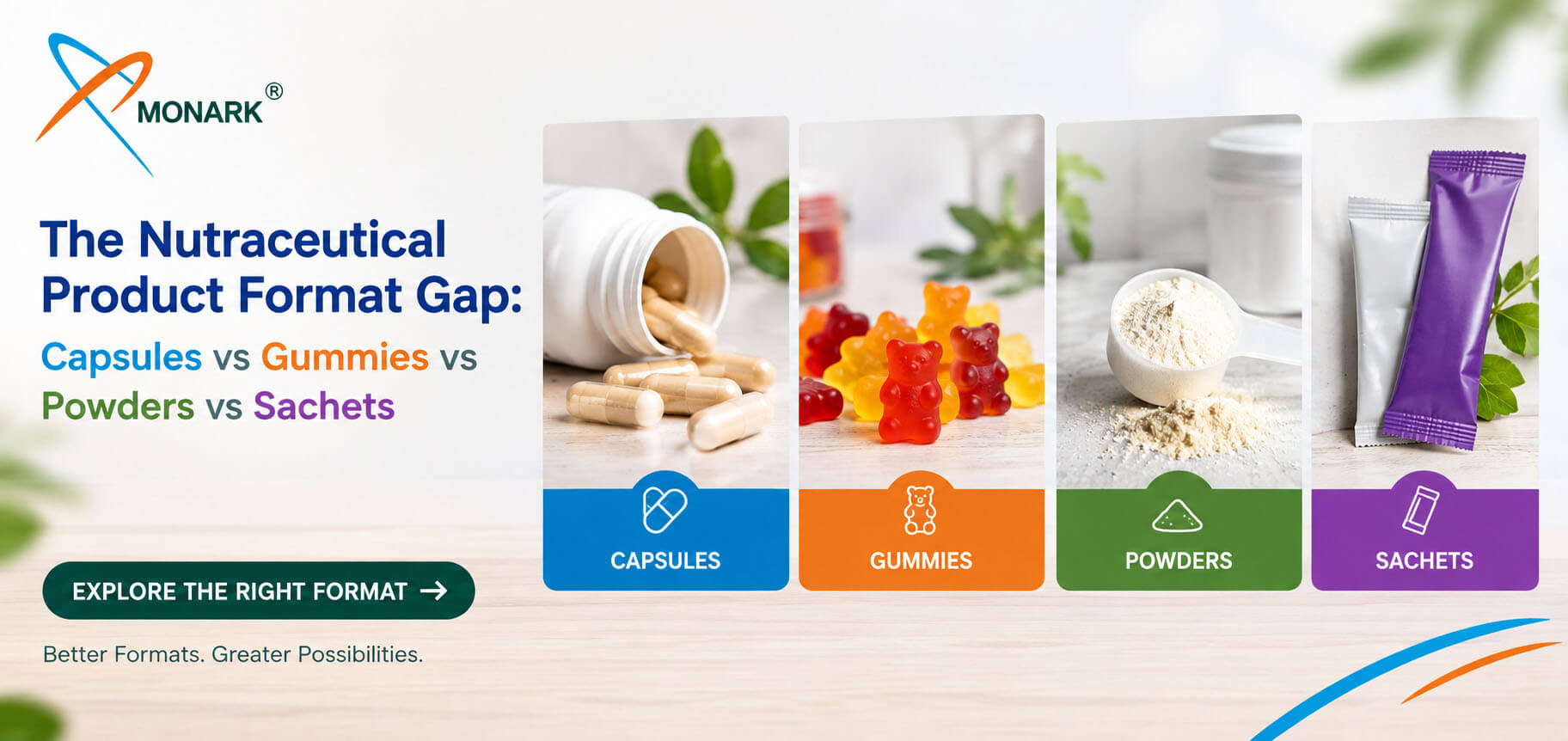
The Supplement Format Showdown: Capsules vs Gummies vs Powders vs Sachets
Same industry. Different formats. Completely different product experiences.
In nutraceutical product development, the ingredient list gets plenty of attention. But another decision deserves just as much thought: how will the consumer actually take the product?
A capsule offers simplicity. A gummy brings a chewable experience. A powder opens up possibilities for flexible serving quantities. A sachet makes individual portions easier to carry.
Yet choosing between these options is rarely as straightforward as it sounds.
A formulation that works beautifully in one format may become difficult to develop in another. Serving size, ingredient compatibility, taste, stability, packaging, and manufacturing capabilities can all influence the final decision.
For nutraceutical brands, understanding the difference between capsules vs gummies vs powders vs sachets is an essential step towards developing products that make sense both technically and commercially.
Let's put the four formats under the spotlight.
Capsules vs Gummies vs Powders vs Sachets: Which Is Best?
Capsules, gummies, powders, and sachets differ in convenience, serving flexibility, taste, and packaging. Capsules provide a compact, measured serving; gummies offer a chewable experience; powders allow flexible serving sizes and formulation options; and sachets provide convenient single-serving packaging, often for powders. The best nutraceutical format depends on the active ingredients, intended serving size, stability requirements, target audience, and manufacturing feasibility.
THE QUICK TAKE: Which Format Does What?
Before diving into the details, here is the essential comparison.
|
Format |
Biggest advantage |
Main challenge |
Consider it when |
|
Capsules |
Compact, measured servings |
Swallowability and unit capacity |
A familiar, compact dosage form is suitable |
|
Gummies |
Chewable, flavoured experience |
Taste, texture and stability |
Consumer experience is a priority |
|
Powders |
Flexible serving quantities |
Mixing, taste and moisture control |
Larger quantities or blends are needed |
|
Sachets |
Portable, individual portions |
Packaging protection and filling accuracy |
Convenient single servings are desirable |
The takeaway: There is no universally superior nutraceutical format. The right choice depends on the formulation, intended audience, serving requirements, and manufacturing feasibility.
ROUND ONE: Capsules — The Compact Contender
Capsules have earned a place in the nutraceutical market because they offer a straightforward way to deliver measured quantities of compatible ingredients.
They are compact, familiar, and available in different forms. Depending on the formulation, conventional capsules can contain powders or granules, while softgels are commonly used for suitable oils and liquid or semi-solid fills.
Where capsules win
-
Convenience: A defined serving can be delivered in a compact unit.
-
Familiarity: Many consumers already incorporate capsules into their supplement routines.
-
Formulation options: Different capsule types accommodate different compatible ingredients.
-
Packaging flexibility: Bottles and blister packs are common options, subject to product requirements.
Where capsules face challenges
Capsules are not suitable for every serving size or consumer. Some people struggle to swallow them, and large quantities of material may require several units per serving.
Ingredient compatibility, shell properties, moisture sensitivity, and appropriate packaging also need consideration.
Verdict: Capsules are worth considering when a compact, measured-dose presentation fits the formulation and target audience.
Explore Monark Biocare's Capsules & Softgel Capsules portfolio for examples of its listed products.
ROUND TWO: Gummies — The Experience-Driven Challenger
What if taking a supplement could involve chewing rather than swallowing a capsule?
That is the appeal of gummy supplements. Their flavour and texture can offer a different consumption experience, making them an option for brands targeting consumers who prefer chewable products.
But attractive presentation alone does not make a successful gummy.
Where gummies win
-
Chewability: They offer an alternative to conventional capsules.
-
Flavour potential: Suitable flavour systems can help manage the sensory challenges of certain ingredients.
-
Brand differentiation: Shape, colour, texture, and presentation can contribute to a distinctive product identity.
Where gummies face challenges
Some active ingredients are bitter, strongly flavoured, or difficult to incorporate into a gummy matrix. Processing conditions, acidity, moisture, and ingredient interactions can affect stability.
The available space within each gummy can also constrain serving quantities. For this reason, some formulations may be more practical in another dosage form.
Verdict: Gummies are worth exploring when a chewable experience supports the product concept and the ingredients can be formulated successfully.
ROUND THREE: Powders — The Flexible Performer
Capsules have a practical size limit. What happens when a product requires a larger serving quantity?
Powders may offer a more suitable route.
Powder supplements can contain compatible ingredients such as selected amino acids, proteins, minerals, and nutritional blends. Depending on the formulation, they may be mixed with water or another suitable liquid before consumption.
Where powders win
-
Serving flexibility: Larger quantities of suitable ingredients may be easier to accommodate.
-
Blend potential: Multiple compatible ingredients can be combined in a formulation.
-
Flavour development: Suitable flavour systems may improve the drinking experience.
-
Packaging choices: Powders can be supplied in jars, tubs, or sachets.
Where powders face challenges
Powders can differ considerably in flow, taste, texture, and mixing behaviour. Some dissolve readily, while others disperse without dissolving completely.
Moisture control, ingredient uniformity, and packaging protection are important considerations throughout manufacturing and storage.
Verdict: Powders deserve attention when the formulation benefits from flexible serving quantities or a mix-before-use preparation method.
ROUND FOUR: Sachets — The Convenience Specialist
Here is an important distinction: a sachet is not necessarily an alternative to powder.
Powder describes the physical form; sachet describes the packaging.
A powder can be packed in a tub or divided into individual sachets. The latter approach can make the product easier to carry and provide a pre-measured serving.
Where sachets win
-
Portability: Individual packs are convenient to transport.
-
Portion control: Each pack can contain a specified quantity.
-
Practical distribution: Single-serving packaging can suit different sales channels.
-
Flexible presentation: Pack dimensions and materials can be selected to meet product requirements.
Where sachets face challenges
Packaging selection is critical. Filling accuracy, seal integrity, material compatibility, and protection from moisture or oxygen, where necessary, all affect product quality.
Verdict: Sachets are worth considering when individual portions and portability are central to the product concept, particularly for suitable powders.
Monark Biocare lists AMINOARK GOLD Sachets, providing an example of sachet-based product presentation.
MYTH VS. FACT: Four Common Format Misconceptions
Myth 1: The most popular format is always the best choice.
Fact: Popularity does not guarantee formulation compatibility. The ingredients, serving size, and intended consumer should guide the decision.
Myth 2: Gummies are automatically easier to formulate.
Fact: Gummies can present significant challenges involving taste, texture, stability, and ingredient loading.
Myth 3: Powders and sachets are competing dosage forms.
Fact: Powder is a physical form, whereas a sachet is a packaging format. They can be used together.
Myth 4: Attractive packaging can compensate for a weak formulation.
Fact: Packaging contributes to presentation and protection, but it cannot replace appropriate formulation development, quality controls, or stability assessment.
THE DECISION MATRIX: Find the Best Fit for Your Product
Before selecting a format, evaluate the product against five practical questions.
|
Question |
What to evaluate |
|
What ingredients are required? |
Compatibility, quantity, taste, and sensitivity |
|
Who is the intended consumer? |
Swallowability, chewability, portability, and preferences |
|
What serving size is needed? |
Unit capacity and preparation requirements |
|
What protection does the product need? |
Moisture, oxygen, light, and storage conditions |
|
Can the product be manufactured consistently? |
Equipment, quality controls, packaging, and production scale |
The answers should guide the decision rather than a trend or competitor's packaging.
For additional background on supplement quality and use, consult the NIH Office of Dietary Supplements. Businesses should also confirm the regulatory and quality requirements applicable to their intended market.
The Next Big Thing in Supplements: Are Personalised Nutrition and Convenient Formats Going Viral?
The nutraceutical industry is moving beyond the simple question of what ingredients are inside a supplement? Today, consumers are also asking: Does it fit my lifestyle, feel convenient to use, and match my daily wellness routine?
This shift is putting personalised nutrition, functional powders, portable sachets, and enjoyable supplement experiences in the spotlight. However, a format becoming popular does not automatically make it the right choice for every formulation.
Here are four trends worth watching:
-
Personalised nutrition: Consumers increasingly seek products tailored to specific goals, such as active lifestyles, daily wellness, and targeted nutritional support. Flexible powder formats may suit some customised serving concepts, depending on the formulation.
-
Convenience-first supplements: Busy professionals, travellers, and fitness enthusiasts often value easy-to-carry products. Single-serving sachets can offer portion convenience without requiring consumers to carry a full container.
-
The rise of enjoyable supplementation: Gummies and flavoured powders can make certain supplement routines more appealing. Their success still depends on ingredient compatibility, taste, stability, and appropriate serving sizes.
-
Format innovation over hype: A viral product may attract attention, but long-term value comes from a suitable formulation, consistent quality, clear labelling, and a format consumers can use as intended.
Which supplement format fits your lifestyle?
Capsules may appeal to consumers who prefer a compact, measured serving. Powders can offer flexibility, while sachets provide convenient single-serve packaging. Gummies may appeal to those who prefer a chewable experience, provided the intended ingredients and serving requirements are compatible with the format.
The takeaway for nutraceutical brands: Don't choose a format just because it is trending. Choose it because it supports the product's ingredients, intended use, target audience, and practical manufacturing requirements.
INSIDE THE MONARK BIOCARE PORTFOLIO
For nutraceutical businesses researching available product options, an existing product portfolio can help illustrate how different formulations are presented.
Monark Biocare lists products including:
These examples represent softgel and sachet-based presentations within the listed range. Their specifications, current availability, and suitability for a particular commercial requirement should be confirmed directly with the company.
Explore the Monark Biocare Nutraceutical Products page to review the available portfolio.
When contacting a potential supplier, prepare your proposed ingredients, target serving size, preferred format, packaging needs, intended market, and expected order quantity. These details help establish whether the proposed product aligns with the supplier's actual capabilities.
For products intended for India, businesses should also verify the applicable Indian regulatory requirements before finalising formulation, labelling, and marketing claims. The US FDA dietary supplements resource provides separate regulatory background for the US market.
From Consumer Needs to Product Choices: Where Monark Biocare Fits In
What makes a nutraceutical product stand out in a crowded market? Sometimes, it is the ingredient. Sometimes, it is the serving experience. And often, it is how well the product format aligns with the needs of its intended audience.
This is where understanding the product portfolio becomes important for healthcare businesses, distributors, and nutraceutical entrepreneurs.
Monark Biocare offers a range of pharmaceutical and nutraceutical products across different formats, including capsules, softgel capsules, sachets, and powder-based products. Its portfolio features AMINOARK GOLD Sachets, EGO-FRESH Softgel Capsules, and ULTRA RICH Softgel Capsules.
Rather than treating every format as interchangeable, businesses should evaluate what each product is designed to deliver. A capsule may suit a compact, measured serving; a softgel may be appropriate for compatible oil-based ingredients; and a sachet may offer convenient packaging for a single serving of powder.
Gummies, meanwhile, represent another format to consider when evaluating consumer preferences, ingredient suitability, flavour requirements, and manufacturing feasibility. Their inclusion in a product strategy should depend on the brand's objectives and formulation needs, not simply on market buzz.
Monark Biocare — Contact Details
-
Address: Plot No. 201, HSIIDC, Alipur, Barwala, Haryana, India
-
Email: monarkbiocare@gmail.com
-
Phone: +91-9855986633 / +91-9023256719 / +91-9888656719
For businesses looking to explore product options and healthcare-sector opportunities, Monark Biocare also offers pharmaceutical manufacturing services, PCD franchise opportunities, and ethical promotion services.
FINAL ROUND: The Winning Format Is the One That Fits
Capsules, gummies, powders, and sachets each solve different product-development challenges.
Capsules offer compact convenience. Gummies introduce a chewable experience. Powders support flexible serving quantities. Sachets make individual portions portable.
The strongest choice is not necessarily the newest or most eye-catching format. It is the one that supports the formulation, meets the needs of the intended consumer, and can be manufactured and packaged appropriately.
For businesses exploring nutraceutical product options, visit Monark Biocare's nutraceutical portfolio and contact the team to discuss specific requirements.
Remember: A successful product does not begin with the format. It begins with understanding what the formula needs to achieve.
FAQ: What Brands Need to Know
1. Which is better: capsules or gummies?
Neither is universally better. Capsules can suit compact measured-dose formulations, while gummies offer a chewable experience. The right choice depends on ingredient compatibility, serving size, stability, and consumer preferences.
2. Are powders suitable for high-dose formulations?
Powders can accommodate larger quantities of suitable ingredients than a single compact capsule in many cases. The appropriate choice still depends on the formulation, serving size, taste, and intended method of consumption.
3. Can a powder supplement be sold in sachets?
Yes. Sachets can package individual servings of compatible powder formulations. Packaging material and seal quality should be selected according to the product's protection requirements.
4. What is the most important factor when choosing a nutraceutical format?
Start with the ingredients and required serving size, then assess stability, consumer needs, packaging, and manufacturing feasibility. No single factor should be considered in isolation.
5. What should brands ask a nutraceutical supplier?
Ask about relevant product capabilities, manufacturing processes, quality systems, ingredient sourcing, testing, packaging options, production capacity, and applicable regulatory requirements.
Disclaimer: The information provided in this article is for general awareness and educational purposes only. Supplement formats and formulations may vary in quality, composition, and suitability. This content should not replace professional medical advice or regulatory guidance. Consult a qualified healthcare professional before using nutraceutical products, and verify product specifications, labelling, and compliance requirements with the relevant manufacturer before making any health-related or commercial decisions.