12th May 2026 | By Admin
Introduction: Where Ethics Meets Pharmaceutical Excellence
In today’s rapidly evolving pharmaceutical industry, competition is intense, but so are expectations. Patients, healthcare professionals, and regulatory authorities all demand one thing above everything else: trust in quality and ethics.
This is where the role of third-party manufacturing companies in maintaining ethics becomes extremely important.
Pharmaceutical brands often rely on outsourcing to meet rising demand, reduce production costs, and scale faster. However, outsourcing without ethical oversight can pose serious risks, including poor-quality production, regulatory violations, and loss of brand credibility.
The challenge is simple but critical:
👉 How can pharma companies ensure ethics while outsourcing production?
The answer lies in strong GMP compliance, transparent systems, and responsible third-party manufacturing partners who prioritize quality over shortcuts.
Let’s explore how ethical manufacturing is maintained in the real world of pharma outsourcing.
Understanding Third-Party Pharmaceutical Manufacturing
Third-party manufacturing, also known as contract manufacturing, is a model where pharmaceutical companies outsource production to specialized manufacturing units.
Instead of building their own infrastructure, brands collaborate with experienced manufacturers who handle formulation, production, packaging, and sometimes even regulatory documentation.
This system is widely used in India and globally because it offers:
-
Faster production scalability
-
Reduced operational cost
-
Access to advanced manufacturing facilities
-
Wider product diversification
Many businesses explore opportunities such as Third-Party Manufacturing to expand their pharma portfolios without significant investment.
Similarly, companies researching PCD Franchise Services often rely on third-party manufacturers for consistent product supply and branding support.
But beyond business benefits, ethics remain the backbone of this ecosystem.
Why Ethics Matter in Pharmaceutical Manufacturing
Pharmaceutical products directly impact human health, so even a minor compromise in quality can lead to serious safety risks, treatment failures, regulatory violations, and loss of trust in both manufacturers and healthcare systems.
Ethics in pharma manufacturing ensures:
-
Patient safety is never compromised
-
Medicines meet approved quality standards
-
Transparent sourcing of raw materials
-
Proper documentation and traceability
Without ethical practices, the entire healthcare system can face trust issues.
That is why leading companies invest heavily in compliance systems and partner only with manufacturers who follow strict ethical guidelines.
If you are exploring trusted manufacturers, resources like Find Reliable Pharmaceutical Companies Near Me can help identify verified partners in your region.
GMP Compliance: The Foundation of Ethical Manufacturing
Good Manufacturing Practices (GMP) form the backbone of ethical pharmaceutical production by ensuring strict quality control, regulatory compliance, and consistent safety standards throughout every stage of drug manufacturing and packaging processes.
GMP ensures that every product is:
-
Consistently produced
-
Controlled under strict quality standards
-
Tested at every production stage
-
Safe for patient consumption
Ethical third-party manufacturers strictly follow GMP guidelines to eliminate risks such as contamination, dosage errors, and substandard production.
Key elements of GMP compliance include:
-
Clean and controlled production environments
-
Qualified and trained workforce
-
Validated equipment and processes
-
Detailed batch records and documentation
-
Regular audits and inspections
Without GMP adherence, ethical manufacturing simply cannot exist.
Role of Third-Party Manufacturers in Maintaining Ethics
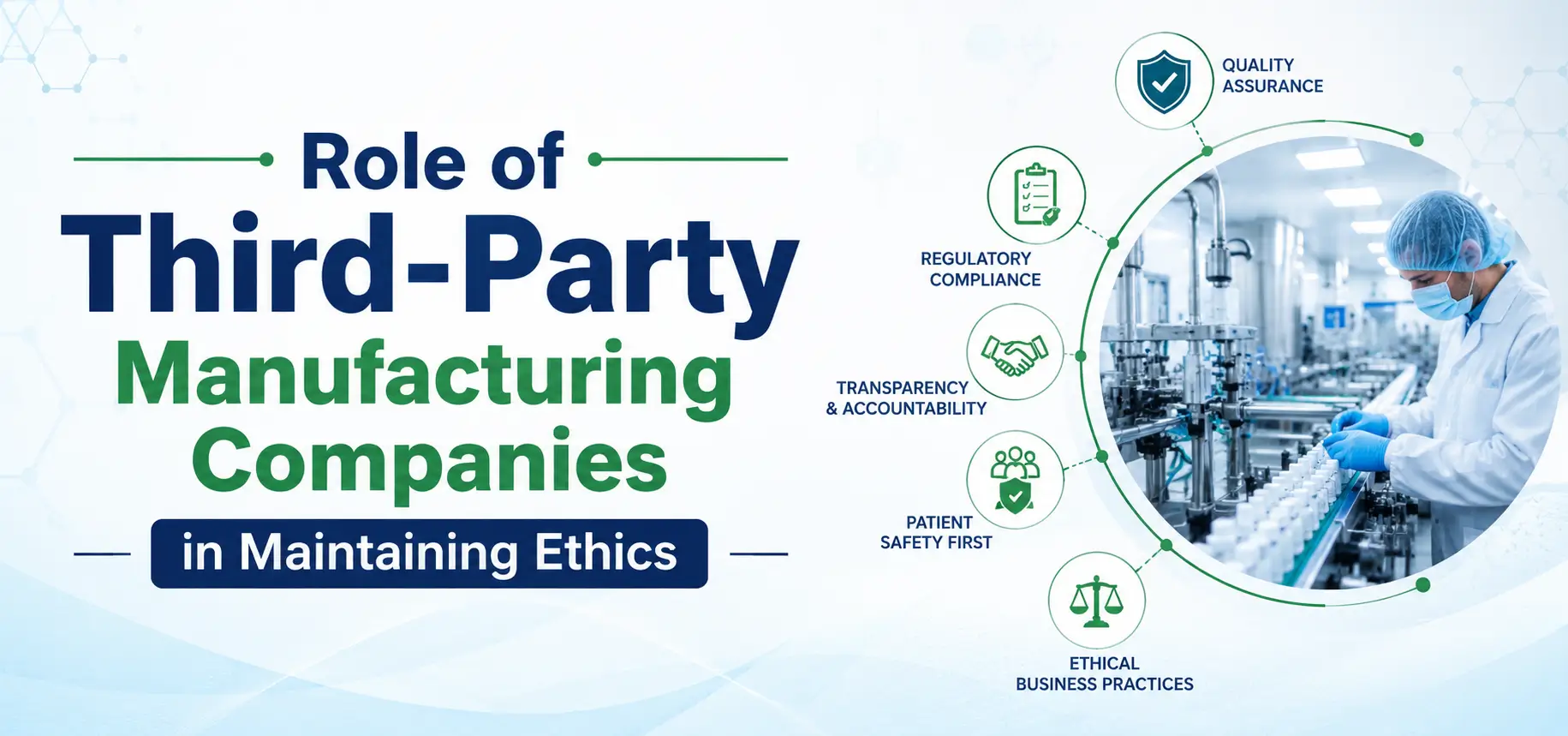
Third-party manufacturing companies play a key role in maintaining ethics by ensuring strict adherence to GMP guidelines, regulatory standards, and transparent production processes across every stage of pharmaceutical manufacturing.
They also support consistent quality control, proper documentation, and unbiased testing practices, which help pharma brands deliver safe and reliable medicines while maintaining trust and compliance in the industry.
1. Ensuring Product Quality Consistency
Ethical manufacturers ensure strict quality control at every stage, from raw material sourcing to production and final packaging, to maintain consistent safety and effectiveness of pharmaceutical products.
2. Maintaining Transparency in Operations
Clients are provided complete visibility into batch processing, quality testing reports, and compliance documentation, ensuring full transparency throughout the entire manufacturing process.
3. Following Regulatory Standards
Manufacturers strictly adhere to national and international regulatory guidelines, including GMP requirements, to ensure legal compliance and safe production practices across all operations.
4. Preventing Cost-Cutting at Quality Level
Ethical manufacturers prioritize product quality over profit margins, ensuring that cost reduction efforts never compromise formulation standards or patient safety.
5. Supporting Pharmacovigilance
They actively support pharmacovigilance by monitoring product performance after market release, helping ensure the long-term safety and effectiveness of pharmaceutical products.
This is especially important in sensitive segments like critical care medicines.
For example, businesses looking into the Critical Care Product List must ensure manufacturing partners follow strict ethical and regulatory standards.
Ethics in Critical Care Pharmaceutical Segment
Critical care medicines are life-saving drugs used in intensive care units, emergency treatments, and critical medical conditions.
Because of their high sensitivity, ethical manufacturing becomes even more crucial here.
Companies offering the Top 10 Pharma Companies for Critical Care Range usually highlight their compliance strength, manufacturing infrastructure, and quality assurance systems.
Ethical production in this segment ensures:
-
Accurate dosage formulations
-
Sterile manufacturing environments
-
High-quality active pharmaceutical ingredients (APIs)
-
Zero tolerance for contamination
Even minor negligence in critical care products can be life-threatening, making ethics non-negotiable.
Challenges in Maintaining Ethics in Pharma Outsourcing
Third-party manufacturing in pharma faces challenges like cost pressure from clients, which can sometimes push manufacturers toward compromising quality standards.
Another major issue is regulatory complexity, as varying compliance rules and supply chain inconsistencies can make it difficult to maintain uniform ethical practices.
Despite strong systems, third-party manufacturing still faces several challenges:
-
Cost Pressure from Brands: Some companies push manufacturers to reduce costs, which can impact quality if not controlled.
-
Regulatory Complexity: Different countries have different compliance rules, making standardization difficult.
-
Lack of Continuous Auditing: Without regular inspections, unethical practices may go unnoticed.
-
Supply Chain Issues: Raw material inconsistency can affect final product quality.
-
Miscommunication Between Brand & Manufacturer: Poor coordination may lead to documentation or formulation errors.
Ethical manufacturers overcome these challenges through strict SOPs, audits, and transparent communication systems.
Read also - How Ethical Promotion Strengthens Long-Term Trust in Healthcare
Comparison: Ethical vs Non-Ethical Manufacturing Practices
|
Factor |
Ethical Manufacturing |
Non-Ethical Manufacturing |
|
Quality Control |
Strict multi-stage testing |
Minimal or skipped testing |
|
Transparency |
Full documentation shared |
Limited visibility |
|
Compliance |
GMP & regulatory adherence |
Ignored or partial compliance |
|
Patient Safety |
Top priority |
Often compromised |
|
Long-Term Reputation |
Strong brand trust |
High risk of failure |
This comparison clearly shows why ethics is not optional; it is essential.
Third-party manufacturing companies maintain ethics in pharmaceuticals by following GMP guidelines, ensuring strict quality control, maintaining transparency in production, and complying with regulatory standards to deliver safe, reliable, and consistent medicines to the market.
Business Growth Through Ethical Manufacturing
Ethical third-party manufacturing not only ensures compliance but also strengthens brand reputation, builds long-term trust, and supports sustainable business growth in the highly competitive pharmaceutical industry.
Companies benefit through:
-
Strong brand reputation
-
Better customer trust
-
Long-term partnership stability
-
Faster regulatory approvals
-
Reduced product recalls
Many growing pharma businesses choose Start Third-Party Manufacturing with Monark Biocare to ensure ethical production standards combined with scalable manufacturing capabilities.
Such partnerships help companies expand while maintaining compliance integrity.
Future of Ethical Pharmaceutical Outsourcing
The future of ethical pharmaceutical outsourcing is moving toward smarter transparency, digital compliance systems, and globally unified quality standards that ensure safer, more reliable, and trust-driven drug manufacturing worldwide.
-
Digital quality tracking systems
-
AI-based compliance monitoring
-
Blockchain-based supply chain transparency
-
Global GMP standard alignment
Ethical manufacturing will no longer be a competitive advantage; it will be a basic requirement.
Companies that fail to adopt transparent and ethical systems will struggle to survive in the evolving pharmaceutical ecosystem.
Ready to Scale Your Pharma Business the Ethical Way?
If you’re looking to grow in the pharmaceutical industry without compromising on quality, compliance, or trust, the right manufacturing partner makes all the difference.
At Monark Biocare, we help you combine ethical third-party manufacturing with scalable production solutions that support long-term business success. From GMP-compliant processes to consistent quality assurance, everything is designed to strengthen your brand in the market.
💡 Let’s Build Something Reliable Together
Whether you’re launching a new range or expanding your existing portfolio, we’re here to support your growth with transparency and quality at every step.
👉 Start your journey today with ethical manufacturing that drives real results:
Start Third-Party Manufacturing with Monark Biocare
Because in pharma, growth is powerful, but ethical growth is unstoppable.
Conclusion: Ethics is the Backbone of Pharma Manufacturing
The role of third-party manufacturing companies in maintaining ethics is fundamental to the pharmaceutical industry’s credibility and growth.
From GMP compliance to transparent operations, from quality assurance to regulatory adherence, ethical manufacturers ensure that every medicine reaching the market is safe, effective, and trustworthy.
In a world where healthcare standards are rising rapidly, ethics is not just a requirement; it is a responsibility.
Whether you are exploring Third-Party Manufacturing, looking into PCD Franchise Services, or expanding your product portfolio, choosing an ethical manufacturing partner is the most important decision you can make.
Because in pharmaceuticals, quality is not just business; it is life.
Frequently Asked Questions (FAQs)
1. What is the role of third-party manufacturing companies in maintaining ethics in pharma?
Third-party manufacturing companies ensure ethics by following GMP guidelines, maintaining transparency in production, ensuring quality control, and complying with regulatory standards to deliver safe pharmaceutical products.
2. How do pharma companies ensure ethical manufacturing through outsourcing?
Pharma companies ensure ethical manufacturing by partnering with GMP-certified manufacturers, conducting regular audits, reviewing quality reports, and maintaining strict documentation throughout the production process.
3. Why is GMP compliance important in third-party pharmaceutical manufacturing?
GMP compliance is essential because it ensures medicines are consistently produced and controlled according to quality standards, reducing risks of contamination, errors, and unsafe formulations.
4. What challenges affect ethical practices in pharmaceutical outsourcing?
Common challenges include cost pressure, regulatory complexity, supply chain inconsistency, lack of continuous monitoring, and communication gaps between brands and manufacturers.
5. How can businesses choose an ethical third-party pharma manufacturer?
Businesses should evaluate certifications, GMP compliance, production transparency, quality assurance systems, and past regulatory track records before selecting a manufacturing partner.