22nd July 2026 | By Admin
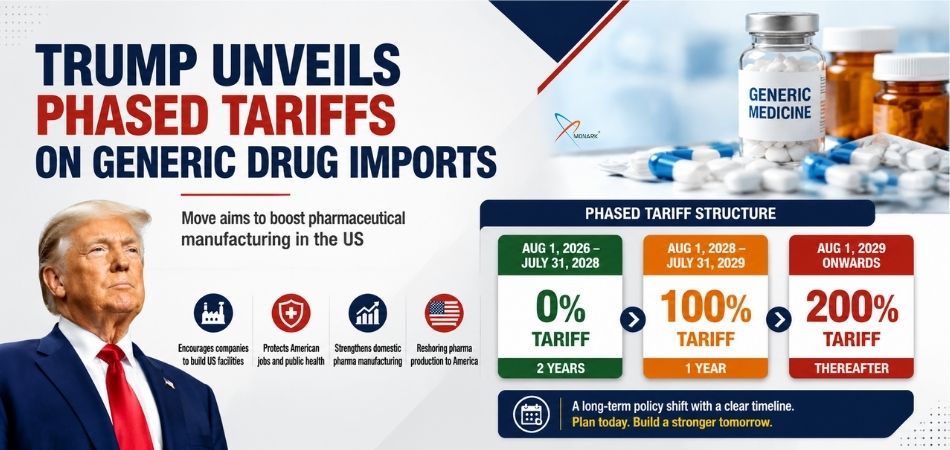
On July 21, 2026, the United States government made it official: Indian generic medicines will stay tariff-free until August 1, 2028 — then face a 100% tariff for one year, rising to 200% after that.
That single sentence should matter deeply to every pharmaceutical professional in India right now.
India exports approximately $30.47 billion worth of pharmaceuticals each year. The US accounts for 31–40% of that total. And generics, the segment with the newly announced tariff clock, represent nearly 70% of India's US-bound pharma exports.
This is not a crisis. It is a two-year runway. The exporters, distributors, pharmacists, and manufacturers who understand what is happening, and act on it, will be in a far stronger position when August 2028 arrives than those who wait.
This article gives you everything you need to know: the confirmed facts, the timelines, the stakeholder-by-stakeholder impact, and the practical steps to take right now.
Key Takeaways
- Patented drugs and APIs face a 100% tariff now, under the April 2, 2026 US Presidential Proclamation (Section 232), effective July 31, 2026 for large companies and September 29, 2026 for others.
- The July 21, 2026 update confirmed that generic medicines stay at 0% tariff until August 1, 2028, then rise to 100% for one year, and 200% after that.
- Generics represent ~70% of India's pharma exports to the US — making August 2028 the most critical planning deadline for most Indian exporters.
- India holds powerful structural advantages: 700+ USFDA-approved manufacturing sites, WHO-GMP-certified facilities, a cost-efficient workforce, and government PLI support for domestic API production.
- PCD pharma franchise and third-party manufacturing models offer clear paths to grow profitably even as export market conditions evolve.
Quick Summary Box
|
Key Detail |
Information |
|
Policy Name |
US Presidential Proclamation — Section 232, Trade Expansion Act 1962 |
|
Original Announcement Date |
April 2, 2026 |
|
July 21, 2026 Update |
Generics confirmed at 0% tariff until August 1, 2028 |
|
Patented Drug Tariff |
100% (effective July 31, 2026 for large firms; September 29, 2026 for others) |
|
Generic Drug Tariff (Now) |
0% |
|
Generic Drug Tariff (from August 1, 2028) |
100% for one year, then 200% |
|
India's Pharma Exports (FY25) |
~$30.47 billion |
|
US Share of India's Pharma Exports |
~31–40% |
|
India's Share of US Generics Market |
35–47% |
|
USFDA-Approved Sites in India |
700+ |
What Is the New US Tariff Policy?
A tariff is a tax on imported goods. The US government invoked Section 232 of the Trade Expansion Act of 1962 to impose a 100% tariff on imported patented pharmaceuticals and APIs, citing national security concerns about dependence on foreign drug supply. Generic medicines were initially excluded, and on July 21, 2026, the US confirmed a defined timeline for when generics will eventually be covered too.
The April 2, 2026, Presidential Proclamation
On April 2, 2026, President Donald Trump signed a presidential proclamation imposing Section 232 tariffs on pharmaceutical imports. The US Commerce Department had determined that import dependence on foreign-manufactured patented drugs and APIs threatened national security, a finding that triggered emergency trade authority.
Key provisions of that proclamation:
- Patented pharmaceuticals and APIs: 100% tariff
- Large companies (listed in Annex III): effective July 31, 2026
- All other companies: effective September 29, 2026
- Generic medicines and biosimilars: Exempt "at this time" — with a one-year review mandated
- Onshoring agreements: Companies with Commerce Department-approved US manufacturing plans pay 20%
- MFN pricing + onshoring: Companies with both qualify for 0%
- Patented drugs from EU, Japan, South Korea, Switzerland, Liechtenstein: 15%
- UK: A reduced rate tied to a bilateral pharmaceutical pricing agreement
- Orphan drugs, nuclear medicines, plasma therapies, and certain speciality products: 0%
The July 21, 2026 Update: The Generics Announcement That Changes Everything
On July 21, 2026, the US administration provided a confirmed timeline for generic medicines — the category that defines India's pharmaceutical export relationship with the US.
- August 1, 2026, to July 31, 2028: Generics remain at 0% tariff
- August 1, 2028, to July 31, 2029: Generics face a 100% tariff
- From August 1, 2029: The tariff rises to 200%
This is the news that should drive every business planning conversation in India's pharmaceutical sector right now. Two years is not a long time. But it is enough — if you start planning today.
Country-Specific Tariff Comparison
|
Country/Group |
Tariff Rate on Patented Drugs |
|
India (standard rate) |
100% |
|
EU, Japan, South Korea, Switzerland, Liechtenstein |
15% |
|
United Kingdom |
Reduced (below 100%, per bilateral deal) |
|
Companies with US onshoring plans |
20% |
|
Companies with MFN pricing + onshoring |
0% |
Indian exporters face a steeper tariff burden than several competing nations. That gap can only be narrowed through onshoring commitments, MFN pricing agreements, or market diversification — all of which require advance preparation.
Why This Matters to Indian Pharmaceutical Exporters
Quick answer: India is the world's largest supplier of generic medicines to the US by volume. The US is India's single largest pharmaceutical export market. Any tariff affecting that relationship — now or in 2028 — reshapes the economics of a $10+ billion annual trade relationship.
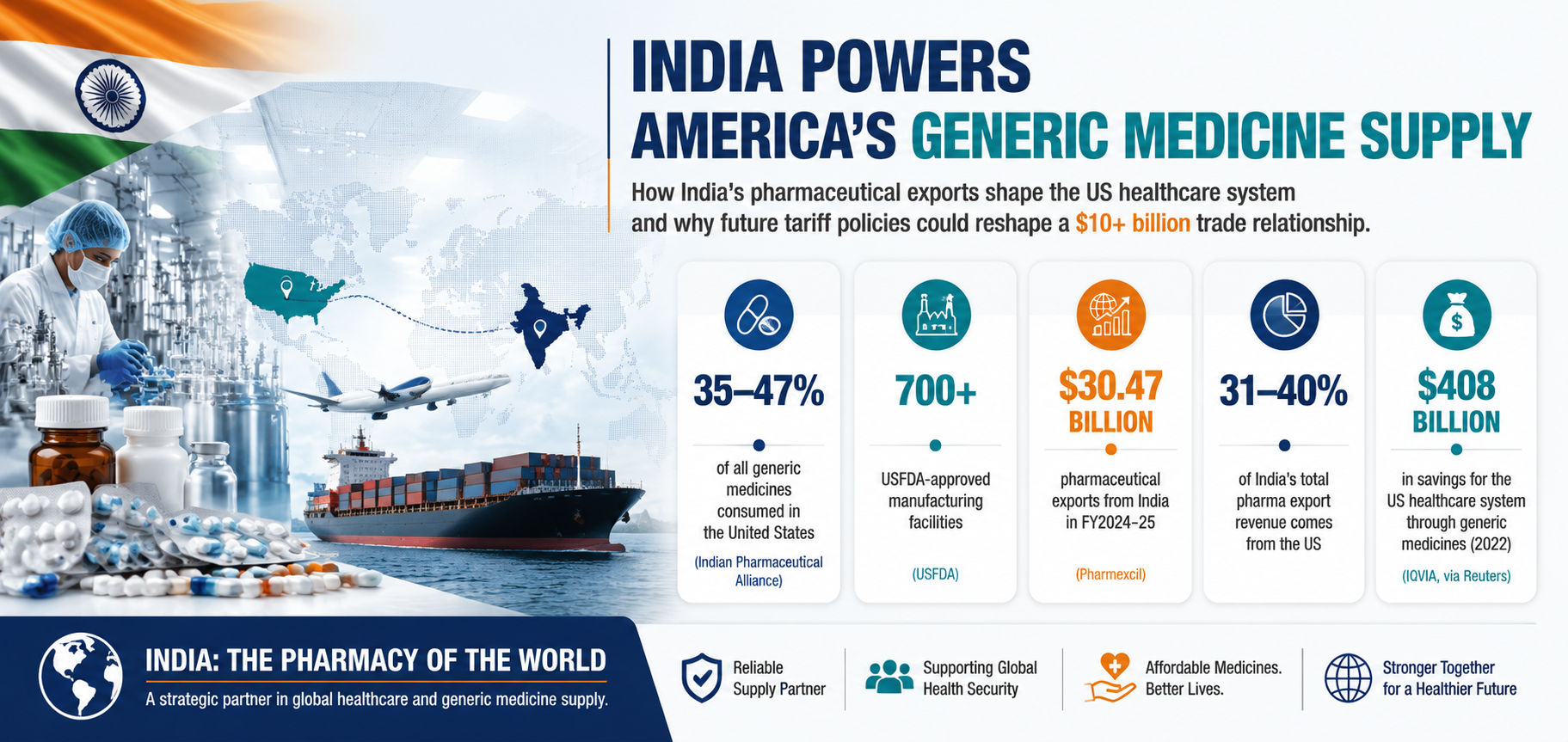
India is often called the "pharmacy of the world". The data backs it up:
- India supplies 35–47% of all generic medicines consumed in the United States (Indian Pharmaceutical Alliance)
- India has 700+ USFDA-approved manufacturing facilities — more than any country outside the US (USFDA)
- Pharmaceutical exports from India reached approximately $30.47 billion in FY2024–25 (PHARMEXCIL).
- The US accounts for 31–40% of India's total pharma export revenue
- Nearly half of all generic prescriptions filled in the US in 2022 were supplied by Indian manufacturers — and generic drugs generated $408 billion in savings for the US healthcare system (IQVIA, via Reuters)
That last figure is the clearest reason why replacing Indian generic supply quickly is not feasible. The US healthcare system is structurally dependent on what Indian manufacturers produce.
For right now, the generic exemption protects the bulk of India's US export revenue. But "right now" has a defined end date. Companies that treat this two-year window seriously will be in a far better position than those who assume the status quo will hold.
Impact on Doctors
Quick answer: Indian doctors prescribing medicines to Indian patients face no direct or immediate impact from this policy. The tariff applies to US imports, not India's domestic drug supply. However, indirect effects on speciality or patented drug availability are worth monitoring over time.
Will Drug Prices Rise for Indian Patients?
Short-term: No. The tariffs target what India sends to the US — not what Indian patients buy at Indian pharmacies. India's domestic drug pricing is governed by the National Pharmaceutical Pricing Authority (NPPA) under the Drugs (Prices Control) Order. Most commonly prescribed medicines are price-regulated and supply-stable.
Longer-term: Watch selectively. If manufacturers reorganise production to respond to US tariff pressure, API prices could shift for certain molecules. Doctors working with imported or speciality formulations – oncology, immunology, rare diseases – should stay alert.
What Doctors Should Do
- Stay updated through CDSCO (Central Drugs Standard Control Organisation) and NPPA notifications
- Continue prescribing based on clinical need and manufacturer quality certification (WHO-GMP and USFDA-approved preferred)
- Engage distributor networks for early signals on any specialty drug availability shifts
- Reassure patients: there is no confirmed shortage linked to this policy
Impact on Pharmacists
Quick answer: Indian pharmacists will see minimal near-term change in generic medicine availability or pricing. The July 21, 2026 update directly protects the category that makes up the vast majority of pharmacy dispensing — generics at 0% tariff until August 2028.
Pharmacists dealing with patented, imported, or specialty drugs may face more pressure:
- Supply-side shifts if patented APIs become costlier or harder to source as manufacturers redirect production
- Availability gaps if exporters adjust their product mix in response to the 100% patented drug tariff (already in effect for large companies from July 31, 2026)
- Brand substitution opportunities — as the market adapts, domestic WHO-GMP generics may become even more prominent as default dispensing choices
Practical Steps for Pharmacists
- Review ordering patterns for patented and imported specialty drugs — identify which are most supply-sensitive
- Build relationships with domestic distributors connected to WHO-GMP certified manufacturers
- Track CDSCO notifications on drug reformulations or substitute molecules
- Be prepared to explain the generic exemption to patients who are anxious after reading news reports
Impact on Pharmaceutical Distributors
Quick answer: Distributors connected to patented drug or API export supply chains face the most immediate planning pressure. Those focused on the domestic Indian market or PCD franchise models are largely insulated. The July 21 update gives all distributors a clearer timeline to plan against.
Key Risks for Distributors
- Revenue from patented export-linked orders may shrink as manufacturers absorb a 100% US tariff (effective July–September 2026 for large and mid-size companies, respectively).
- API price volatility: APIs now face 100% US tariffs. Supply volume shifts could affect both domestic availability and pricing for certain molecules
- Cash flow disruptions if export-linked manufacturer clients face US revenue pressure and extend payment timelines
Key Opportunities for Distributors
- Domestic demand is growing. India's pharmaceutical market is expanding at approximately 10–12% per year. Distributors serving Tier 2 and Tier 3 cities are particularly well-positioned.
- Alternative export markets: Manufacturers are actively redirecting to Africa, Southeast Asia, the Middle East, and Latin America. Distributors supporting those channels are gaining new business.
- PCD Pharma Franchise: Operating with monopoly rights in defined territories, PCD franchise partners are insulated from export-side tariff risk and benefit from domestic demand growth.
Will Medicine Prices Increase in India?
Quick answer: Not immediately, and not for most medicines. The NPPA regulates domestic drug prices. The US tariff affects exports, not Indian domestic sales. Longer-term indirect effects are possible for certain speciality or API-dependent categories.
|
Drug Type |
US Tariff Status |
Impact on Indian Market Prices |
|
Patented drugs (exported to US) |
100% tariff — active from July/Sept 2026 |
Possible indirect adjustments over time |
|
Generic drugs (exported to US) |
0% until August 1, 2028 |
Minimal near-term impact |
|
APIs exported to US |
100% tariff — active from July/Sept 2026 |
Watch for domestic supply/pricing shifts |
|
Domestically sold generics |
Not directly affected |
NPPA-regulated — stable |
|
Biosimilars |
Exempt "at this time" |
No immediate impact |
|
Imported specialty drugs |
Indirect global market pressure |
Monitor availability changes |
The NPPA's price control framework under the Drugs (Prices Control) Order is the most important buffer for Indian consumers in the current environment. For most Indian patients, this policy changes very little in the near term.
Why Experts Believe Indian Pharma Will Remain Strong
Quick answer: India's pharmaceutical sector has structural advantages that a trade tariff cannot quickly dismantle — regulatory credibility, manufacturing scale, cost efficiency, and government support.
1. USFDA Credibility at Scale
India holds 700+ USFDA-approved manufacturing sites — a number no other country outside the US can match. (USFDA, Drug Establishment Registrations) This regulatory track record took decades to build and represents the foundation of India's access to the US market. That access does not vanish with a tariff — it becomes more valuable, because few other countries can replicate it.
2. Cost Competitiveness
Indian manufacturers produce generic medicines at significantly lower cost than US or European counterparts. Even if a 100% tariff applies from 2028, for many molecules the landed cost of Indian generics in the US may still be competitive—because the underlying manufacturing cost differential is that large. (Reuters analysis, April 2025)
3. Government Support — The PLI Scheme
India's Production Linked Incentive (PLI) scheme for pharmaceuticals and APIs provides direct financial incentives for domestic manufacturing investment. The scheme reduces API import dependence (currently significant for inputs sourced from China) and strengthens India's long-term position in global supply chains. (Ministry of Chemicals & Fertilizers, India)
4. Accelerating Market Diversification
Indian pharmaceutical exporters are already growing their presence in Africa, the Middle East, ASEAN, and Latin America. The US tariff pressure accelerates a diversification trend that was already underway — reducing concentration risk across the entire sector.
5. Global Regulatory Trust
India's manufacturing ecosystem is backed by WHO-GMP certifications, USFDA approvals, EU-GMP recognitions, and CDSCO oversight. This multi-regulator trust is a durable competitive advantage that positions Indian manufacturers as reliable partners across regulated and semi-regulated markets globally. (WHO Prequalification Programme)
Expert Insight: "India supplies nearly 47% of generic medicines used in the US. Replacing that capacity overnight is simply not possible. The structural dependency works in India's favour." — Indian Pharmaceutical Alliance (ipa-india.org)
Expert Insight: "The PLI scheme for pharmaceuticals and APIs is our strongest policy response. It reduces import dependency and builds self-reliance at the formulation and ingredient level." — Ministry of Commerce and Industry, India (commerce.gov.in)
Expert Insight: "With over 700 USFDA-approved plants, India's regulatory credibility is not built overnight. That trust is a long-term competitive moat." — Pharmexcil (pharmexcil.com)
Note: Quotes represent publicly documented organisational positions. Always verify the latest statements directly from official sources.
Opportunities the Policy Creates for Indian Pharma
Every significant trade disruption reshapes competitive positioning. The exporters who adapt early capture the advantage. Here is where the opportunities are.
Domestic Market Growth
India's pharmaceutical market is growing at approximately 10–12% annually — and with over 1.4 billion people and rising healthcare access, that trajectory is durable. PCD pharma franchise businesses and third-party manufacturers serving the domestic market are well-insulated from US export risk and positioned to capture this domestic growth.
API Self-Reliance
India's PLI scheme is directly accelerating domestic API manufacturing. Companies investing in API backward integration now will enter the 2028 tariff transition period with lower cost structures and less supply chain vulnerability.
Alternative Export Markets
Africa, Southeast Asia, Eastern Europe, and Latin America have growing demand for affordable, WHO-GMP-certified generic medicines — exactly what Indian manufacturers produce best. Expanding into these markets requires regulatory investment, but it distributes revenue risk and creates sustainable long-term growth. (Pharmexcil Market Expansion Data)
Third-Party Manufacturing (CDMO) Demand
As large exporters restructure their supply chains in response to the tariff environment, demand for reliable third-party manufacturing partners with strong compliance records is rising. WHO-GMP and ISO-certified manufacturers are particularly well-positioned.
Licensing and Technology Transfer
Indian companies with proprietary formulations or manufacturing processes may find licensing opportunities with US-based partners who are onshoring production under the new tariff incentive structure. This opens a revenue channel without direct tariff exposure.
What Doctors, Pharmacists & Distributors Should Do Right Now
Checklist for Doctors
- Stay informed about updates from CDSCO and NPPA regarding medicine availability and regulatory changes.
- Familiarise yourself with biosimilars and high-quality domestic generic alternatives across key therapeutic areas.
- Maintain regular communication with distributors to monitor the availability of speciality and imported medicines.
- Keep track of developments in the Indian pharmaceutical industry that may influence product supply.
- Reassure patients that, at present, there are no officially confirmed nationwide shortages of essential or speciality medicines.
Checklist for Pharmacists
- Review your inventory to identify reliance on patented or imported speciality medicines.
- Diversify sourcing by strengthening relationships with reliable domestic suppliers.
- Monitor regulatory updates related to medicine pricing and availability.
- Maintain adequate stock of therapeutic alternatives from quality-certified Indian manufacturers.
- Stay updated on newly approved biosimilars and their availability to support uninterrupted patient care.
Checklist for Pharmaceutical Distributors
- Assess your business exposure to patented medicines and export-dependent supply chains.
- Review manufacturer partnerships to understand potential supply risks and diversify where necessary.
- Expand domestic business opportunities through new distribution channels and regional partnerships.
- Align with manufacturers serving both domestic and diversified international markets to improve supply resilience.
- Evaluate third-party manufacturing partnerships to strengthen supply continuity.
- Build relationships with quality-certified manufacturers to ensure a reliable and compliant supply chain.
- Incorporate long-term supply chain resilience and market diversification into your strategic business planning.
Frequently Asked Questions
Frequently Asked Questions
1. What is the new US Section 232 tariff on pharmaceuticals? +
Section 232 of the Trade Expansion Act of 1962 gives the US President authority to impose tariffs on imports that threaten national security. On April 2, 2026, this provision was used to impose a 100% tariff on patented pharmaceuticals and APIs. Generic medicines were excluded — and the July 21, 2026 update confirmed a specific 0%-to-100%-to-200% timeline for generics starting August 2028.
Source: White House Proclamation
2. When does the 100% tariff on patented drugs take effect for Indian companies? +
For large Indian pharmaceutical companies (listed in Annex III of the proclamation), the tariff was effective from July 31, 2026. For all other companies, it applies from September 29, 2026.
Source: White House Proclamation
3. Are generic medicines currently affected by the US tariff? +
No — not yet. As of the July 21, 2026 update, generics remain at 0% tariff until August 1, 2028, after which a 100% tariff applies for one year, rising to 200% permanently after that.
Source: Reuters, July 21, 2026
4. How much of India's US pharma exports are generic medicines? +
Approximately 70% of India's pharmaceutical exports to the US are generic medicines — which is why the 2028 deadline is the most consequential date for most Indian exporters.
Source: Pharmexcil
5. Will domestic medicine prices in India increase due to these tariffs? +
No immediate price increase is expected. The NPPA regulates essential medicine prices in India, providing a buffer for Indian patients. The US tariff affects exports to the US, not medicines sold within India.
Source: NPPA
6. How many USFDA-approved manufacturing plants does India have? +
India has more than 700 USFDA-approved manufacturing sites — the highest number of any country outside the United States.
Source: USFDA
7. Can Indian exporters reduce or avoid the tariff on patented drugs? +
Yes. Companies that commit to US onshoring plans face only a 20% tariff instead of 100%. Companies that combine MFN (Most Favoured Nation) pricing agreements with onshoring qualify for a 0% tariff.
Source: White House Proclamation
8. What is the PLI scheme, and how does it help Indian pharma exporters? +
The Production Linked Incentive (PLI) scheme is an Indian government programme that provides financial incentives for domestic pharmaceutical and API manufacturing. It reduces dependence on imported Chinese APIs and strengthens India's long-term supply chain position.
Source: Ministry of Chemicals & Fertilizers
9. How does the US tariff affect Indian API manufacturers? +
APIs face the same 100% tariff as patented drugs, effective July–September 2026. This significantly raises the cost of sending Indian APIs to the US. Manufacturers are being encouraged to redirect API production toward domestic supply and alternative export markets, supported by the PLI scheme.
Source: White House Proclamation
10. Which countries face a lower tariff than India on patented drugs? +
The EU, Japan, South Korea, Switzerland, and Liechtenstein face a 15% tariff on patented pharmaceuticals. The UK faces a reduced rate tied to a bilateral pricing agreement. India, without onshoring commitments, faces the full 100% tariff on patented drugs and APIs.
Source: White House Proclamation
11. How does this affect PCD pharma franchise businesses in India? +
PCD pharma franchise businesses operating in the domestic Indian market are largely insulated from this policy. The tariff targets exports to the US — not domestic pharmaceutical business activity. Franchise operators can continue to grow by focusing on domestic demand and territorial expansion. Learn about PCD Franchise opportunities
12. What should a pharmaceutical distributor do to protect their business now? +
Distributors should audit their revenue exposure to patented drug and API export supply chains, strengthen ties with domestic WHO-GMP certified manufacturers, explore PCD franchise models, and identify alternative export markets. Mark August 2028 as a strategic planning deadline and begin building toward it today. Explore Monark Biocare's distributor partnerships
13. Is India at risk of losing the US pharmaceutical market permanently? +
Not in the short term. India supplies 35–47% of all generic medicines used in the US — a volume that the US healthcare system cannot quickly replace. However, the 2028 generic tariff deadline is a real long-term challenge that demands strategic preparation starting now.
Source: Indian Pharmaceutical Alliance
14. What role does Pharmexcil play in this situation? +
Pharmexcil (the Pharmaceuticals Export Promotion Council of India), operating under the Ministry of Commerce and Industry, represents Indian pharmaceutical exporters, publishes export data, and advocates for favourable international trade terms. Exporters should monitor its official communications actively. Pharmexcil official website
15. How should Indian pharma companies prepare for the 2028 generic tariff deadline? +
Start now. Key actions include exploring US onshoring or MFN pricing structures, diversifying into non-US export markets, expanding domestic presence through PCD franchise and third-party manufacturing models, and investing in API self-sufficiency through the PLI scheme. Three years moves faster in practice than it looks on a calendar. Contact Monark Biocare to discuss your strategy
The Opportunity Is Still Larger Than the Risk
Here is the honest summary: the July 21, 2026, news is not a threat disguised as good news. It is a genuinely positive development for Indian generic exporters: a confirmed two-year window of zero tariffs paired with a realistic long-term warning that the status quo will not last forever.
That combination is exactly the kind of signal that good businesses use to make better decisions.
For patented drug exporters, the pressure is already real and immediate; the 100% tariff is live. For generic exporters, distributors, PCD franchise operators, and third-party manufacturers, the near-term picture is stable. The medium-term picture requires planning. And the long-term picture rewards those who diversify, invest in quality, and build resilient supply chains now.
India's pharmaceutical industry has built something that trade policy alone cannot erase: 700+ USFDA-approved plants, a WHO-GMP-certified manufacturing base, government backing through the PLI scheme, and a domestic market growing at double digits every year.
The right response is not panic. It is clarity, preparation, and partnership.
Key Takeaways:
- The July 21, 2026 update confirmed generics at 0% tariff until August 1, 2028
- Patented drugs and APIs already face 100% tariff — active from July 31, 2026 for large companies
- India supplies 35–47% of all US generic medicines – an irreplaceable supply in the short term
- The PLI scheme, domestic market growth, and market diversification are the three strongest strategic responses
- Partner with WHO-GMP and USFDA-approved manufacturers to stay compliant and competitive regardless of how the policy evolves