14th July 2026 | By Admin
India has one of the world's largest pediatric populations—roughly 26% of the country's people are children aged 0–16. That's hundreds of millions of young patients who need safe, effective, child-appropriate medicines every single day. For pharma entrepreneurs, distributors, and medical representatives, this creates a business opportunity that is both commercially compelling and genuinely meaningful.
The pediatric pharmaceuticals segment is growing fast. According to Towards Healthcare Research (July 2026), the global pediatric drugs market was valued at USD 182.39 billion in 2026 and is projected to reach USD 513.98 billion by 2035, expanding at a CAGR of 12.2%. India's share of that growth is significant, driven by government health missions, rising parental health awareness, and an expanding network of registered pharma franchise partners.
This guide covers everything you need to know about building or joining a pediatric PCD pharma franchise, from the complete pediatric product range to profit margins, quality standards, marketing support, and how to choose the right pharmaceutical company to partner with.
What Is a Pediatric PCD Pharma Franchise?
A Pediatric PCD (Propaganda Cum Distribution) Pharma Franchise is a business arrangement where a pharmaceutical company grants the right to distribute and market its pediatric medicines to an individual or business entity within a defined geographic territory. The franchise partner sells these products under the company's brand name or as per the agreed terms, without needing to manufacture anything themselves.
The model is especially effective in the pediatric segment because child healthcare products require specialised formulations—smaller doses, palatable flavours, age-appropriate delivery formats, that most general distributors cannot source easily on their own.
How Does the Pediatric Franchise Business Work?
The process is straightforward:
- Select a certified pediatric pharma company with a strong, DCGI-approved product portfolio.
- Apply for franchise rights in your preferred territory.
- Receive monopoly or semi-exclusive rights to distribute the company's pediatric range in that area.
- Place orders for products as per market demand, at agreed trade prices.
- Sell to hospitals, clinics, chemists, stockists, and medical stores at retail/wholesale prices.
- Earn margins on every product sold.
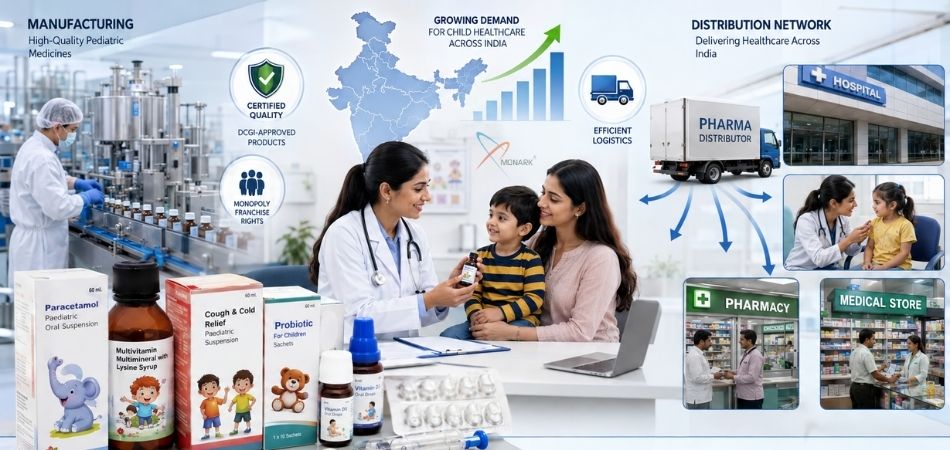
The franchise partner bears the distribution cost. The manufacturing company handles production, quality control, packaging, and logistics to the point of dispatch.
Why Pediatric Medicines Are Among the Fastest-Growing Pharma Segments in India
Several converging factors are driving demand:
- Large child population: India's children represent a substantial and consistent market for healthcare products.
- Government health initiatives: Programs like the National Health Mission (NHM), Rashtriya Bal Swasthya Karyakram (RBSK), and Pradhan Mantri Bharatiya Janaushadhi Pariyojana increase access to and awareness of pediatric medicines.
- Rising parental awareness: Urban and semi-urban parents are more proactive about child health, increasing demand for branded, quality-assured pediatric formulations.
- Seasonal disease patterns: Respiratory infections, diarrhea, and fever are perennial concerns in children, maintaining steady year-round demand.
- Asia-Pacific growth trajectory: The Asia-Pacific region is projected to be the fastest-growing market for pediatric drugs globally (Towards Healthcare Research, 2026).
Market Demand for Child Healthcare Products
Children's weaker immune systems make them vulnerable to respiratory disorders, gastrointestinal infections, vitamin deficiencies, and febrile illnesses. According to Towards Healthcare Research (2026), the respiratory drugs segment holds the largest share of the global pediatric drugs market, followed by gastrointestinal and antibiotics categories. These therapeutic areas form the backbone of any viable pediatric PCD franchise product list.
Complete Pediatric Product Range
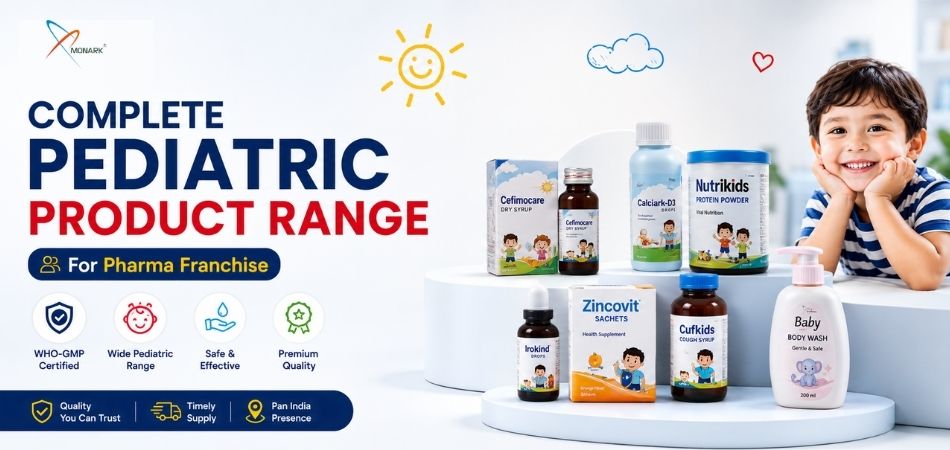
A well-structured complete pediatric product range for PCD pharma franchise business should cover multiple dosage forms and therapeutic areas. Here is a breakdown of what a comprehensive portfolio should include:
Pediatric Syrups
Syrups are the most prescribed dosage form for children due to ease of swallowing and dosage flexibility. Core product types include:
- Paracetamol Syrup – For fever and mild pain management
- Antibiotic Syrups (Amoxicillin, Azithromycin, Cefixime) – For bacterial infections
- Cough and Cold Syrups (Ambroxol, Salbutamol, Phenylephrine combinations) – For respiratory infections
- Multivitamin Syrups – For nutritional support and immune health
- Iron and Folic Acid Syrups – For anemia prevention and management
- Calcium with Vitamin D3 Syrups – For bone-development support
Pediatric Dry Syrups
Dry syrups offer longer shelf life and are ideal for antibiotic delivery. Key molecules include:
- Cefixime Dry Syrup – Broad-spectrum antibiotic for UTIs and ear/throat infections
- Amoxicillin + Clavulanic Acid Dry Syrup – For resistant bacterial infections
- Azithromycin Dry Syrup – Community-acquired pneumonia and skin infections
- Cefpodoxime Dry Syrup – For ENT and respiratory tract infections
- Cefuroxime Dry Syrup – For moderate bacterial infections in children
Pediatric Oral Drops
Drops are critical for neonates and infants who cannot swallow tablets or syrups easily:
- Vitamin D3 Drops – Prevention of rickets and immune support
- Iron Drops – For early-stage iron deficiency anemia
- Zinc Drops – Immunity and growth support
- Multivitamin Drops – Comprehensive early-nutrition support
- Colic Drops (Simethicone-based) – For gas pain and abdominal discomfort in infants
Pediatric Suspensions
Suspensions are used when the active ingredient is not soluble and must be administered uniformly:
- Antibiotic Suspensions – For systemic bacterial infections
- Antipyretic Suspensions (Ibuprofen) – For fever and inflammatory conditions
- Digestive Enzyme Suspensions – To support digestion and appetite
Pediatric Tablets (Chewable and Dispersible)
For older children who can chew or dissolve tablets:
- Chewable Paracetamol Tablets – For older toddlers and school-age children
- Dispersible Antibiotic Tablets – For accurate dose administration in smaller children
- Chewable Multivitamin Tablets – Flavored, child-friendly nutrient delivery
Pediatric Sachets
Sachets offer precise dosing, convenience, and easy administration:
- ORS Powder Sachets – For rehydration during diarrhea
- Probiotic Sachets – Gut health restoration
- Zinc Sachets – Immunity and wound healing support
- Electrolyte Sachets – For rapid rehydration in dehydration cases
Pediatric Nutraceuticals
Nutritional products are a rapidly growing sub-segment:
- Protein Powders – For growth, development, and malnourishment management
- DHA and Omega-3 Supplements – For brain development and cognitive function
- Immunity Booster Formulations – Combinations of Vitamin C, Zinc, and antioxidants
- Appetite Enhancer Syrups – Containing cyproheptadine or herbal alternatives
- Brain Development Supplements – DHA, choline, and B-vitamins for neurological support
Pediatric Topical Products
Baby care and dermatological products represent a distinct category with strong retail demand:
- Baby Creams and Moisturizers – For soft, sensitive skin
- Baby Lotions – For daily skincare
- Baby Soaps and Shampoos – Gentle, tear-free formulations
- Baby Massage Oils – For newborn care and growth
- Diaper Rash Creams – For diaper dermatitis and skin protection
Pediatric Injectables
Injectable formulations are used in hospital and clinical settings
- Antibiotic Injectables (Ceftriaxone, Amikacin) – For severe systemic infections
- Vitamin Injectables (Vitamin K, Vitamin B12) – For deficiency management
- Emergency Care Injectables – For acute clinical situations
Benefits of Offering a Complete Pediatric Product Range
A limited product list forces doctors and chemists to source from multiple suppliers. A complete pediatric product range for PCD pharma franchise partners solves that problem directly—and creates several competitive advantages:
- One-stop supply: Prescribers prefer partners who can fulfill all pediatric prescriptions from a single source.
- Higher revenue per account: When a franchise partner covers syrups, sachets, nutraceuticals, and topicals, each customer relationship generates more revenue.
- Stronger doctor relationships: Physicians trust partners who provide end-to-end solutions for their pediatric patients.
- Better inventory management: A diverse range reduces over-dependence on any single product category.
- Reduced competition risk: Companies offering limited ranges are easier to displace; comprehensive portfolios create stickiness.
Why Doctors Prefer Complete Pediatric Product Portfolios
Pediatricians and general practitioners deal with a broad spectrum of childhood ailments—from the routine (cold, fever, diarrhea) to the chronic (anemia, respiratory disorders, malnutrition). When a medical representative presents a complete portfolio, the doctor can trust one supplier for:
- Acute infection management (antibiotics, antipyretics)
- Nutritional gap coverage (multivitamins, iron, calcium, DHA)
- Supportive care (probiotics, digestive enzymes, colic drops)
- Preventive care (immunity boosters, ORS)
Doctors working in semi-urban or rural areas particularly value this, access to diverse, quality pediatric medicines from a single franchise partner reduces the logistical burden of managing multiple suppliers. A complete portfolio signals professionalism and reliability.
.jpg)
Investment Required and Expected ROI
Starting a pediatric PCD pharma franchise does not require a large upfront capital. The typical investment structure looks like this:
|
Expense Head |
Estimated Range (INR) |
|---|---|
|
Initial Product Stock |
₹20,000 – ₹1,00,000 |
|
Franchise/Agreement Fee |
₹10,000 – ₹50,000 |
|
Marketing Materials (initial) |
₹5,000 – ₹20,000 |
|
Transportation and Logistics |
₹5,000 – ₹15,000 |
|
Total Estimated Investment |
₹40,000 – ₹185,000 |
Return on investment varies based on territory size, doctor reach, and product demand. However, given that net profit margins in pharma franchises typically settle between 10 and 25%, most franchise partners recover initial investment within 3–6 months of active operations.
Profit Margins in Pediatric Pharma Franchise
Profit margins in the pediatric PCD franchise model are one of its most attractive features. According to industry data from Iscon Life Sciences:
- Gross Profit Margins: 20% to 50% across product categories
- Net Profit Margins: 10% to 25% after accounting for marketing, logistics, and operational costs
- High-margin categories: Injectables, specialty nutraceuticals, and branded OTC products typically deliver margins toward the higher end of the range
- Volume categories: Antibiotics and basic syrups move in higher quantities, compensating for relatively lower per-unit margins
Pediatric nutraceuticals and branded baby care products often deliver the strongest margins, making them a valuable addition to any franchise partner's portfolio.
Documents Required to Get Started
The documentation process for a pediatric PCD pharma franchise is standardized and manageable. Here is what you typically need:
- Drug License (DL): Issued by the State Drug Control Department; mandatory for all pharma distributors
- GST Registration Certificate: Required for business transactions
- PAN Card: For tax identification and financial documentation
- Aadhaar Card: For identity verification Business
- Registration Certificate: Sole proprietorship, partnership deed, or company registration, as applicable
- Bank Account Details: For payment processing and agreements
Most reputable pharma companies will guide franchise applicants through the documentation process as part of their onboarding support.
Marketing Support You Should Expect
Marketing support is what separates a strong franchise partnership from a transactional supplier relationship. When evaluating a pediatric pharma company for franchise, look for the following support offerings:
- Visual Aids: Product detail literature for MR presentations to doctors
- Product Cards (LBLs): Leave-behind literature highlighting product benefits, indications, and dosage
- MR Bags and Promotional Items: Branded bags, pens, notepads, and desktop items for daily doctor visits
- Product Samples: For trial and demonstration with prescribers
- Catch Covers and Reminder Cards: For ongoing prescription reminders
- Digital Marketing Materials: Social media content, WhatsApp marketing templates, and e-detailers
- Training and Product Knowledge: Briefings on product indications, competitive positioning, and sales techniques
Franchise partners who receive strong marketing support from their pharma company build doctor relationships faster and achieve breakeven sooner.
Monopoly Rights Explained
Monopoly rights are one of the defining advantages of the PCD pharma franchise model. Here is what they mean in practice:
- Territory Allocation: The pharma company designates a specific geographic area—a district, taluka, or set of pin codes—exclusively to you. No other franchise partner of the same company can operate in that territory.
- Competition Protection: You do not have to compete with other distributors selling the same brand within your zone.
- Business Stability: Monopoly rights create a predictable business environment, making it easier to build long-term relationships with doctors and chemists.
- Expansion Opportunity: As your business grows, you can negotiate for adjacent territories.
Not all companies offer true monopoly rights. Confirm the scope and terms of your territorial exclusivity before signing any agreement.
Quality Standards: WHO-GMP, ISO, DCGI, and CDSCO
Quality is non-negotiable in pediatric pharmaceuticals. Children's physiology is fundamentally different from adults'—smaller bodies, developing organs, and unique metabolic pathways mean that dosing errors or substandard formulations carry serious consequences. Always verify the following certifications when choosing a franchise partner:
|
Certification |
What It Means |
|---|---|
|
WHO-GMP |
World Health Organization Good Manufacturing Practices—ensures manufacturing meets international quality benchmarks |
|
ISO Certified |
Confirms quality management systems are documented, audited, and maintained |
|
DCGI Approved Products |
Drug Controller General of India approval confirms each product has cleared India's regulatory safety and efficacy requirements |
|
CDSCO Compliant |
Alignment with Central Drugs Standard Control Organisation standards for production, labeling, and distribution |
|
GLP Certified |
Good Laboratory Practices certification ensures reliable quality control testing |
A pharma company holding WHO-GMP, ISO, and GLP certifications with DCGI-approved products meets the standard required for both ethical practice and legal compliance.
Product Pricing and Margin Structure
Competitive pricing in pediatric medicines must balance affordability (especially in rural and semi-urban markets) with margin viability for franchise partners. The right pricing structure includes:
- MRP (Maximum Retail Price): Set at a level competitive with the market while protecting brand value
- PTR (Price to Retailer): Typically 70–80% of MRP, allowing chemists a healthy retail margin
- PTS (Price to Stockist): Usually 60–75% of MRP, allowing stockists their margin above PTR
- Franchise Purchase Price: The rate at which the franchise partner procures from the company, providing room for a profitable margin stack
A good pediatric pharma company provides a PTR/PTS calculator or margin table as part of its franchise documentation so partners can plan cash flows before placing orders.
Distribution Network and Logistics
A pediatric PCD franchise is only as strong as its supply chain. Delayed deliveries, stockouts, and quality issues in transit can cost franchise partners both revenue and doctor trust. What to look for:
- Pan India Presence: The company should be capable of supplying across all states and territories
- Inventory Availability: Adequate stock holding to fulfill orders without backlogs
- Timely Dispatch: Standard production and dispatch timelines of 20–30 days for custom orders; faster for in-stock products
- Secure Packaging: Temperature-sensitive pediatric products—especially syrups, drops, and some nutraceuticals—must be packed to withstand transit conditions
- Track and Trace: Dispatch documentation and consignment tracking to ensure accountability
Pediatric healthcare remains one of the most resilient and steadily growing segments within India's pharmaceutical industry. For franchise partners, offering a complete pediatric product range — spanning syrups, dry syrups, drops, suspensions, tablets, capsules, sachets, nutraceuticals, and baby care products — isn't just a competitive advantage; it's increasingly what doctors and parents expect from a serious, trustworthy partner.
Monark Biocare, a WHO-GMP certified pharmaceutical company based in Chandigarh, offers a genuinely complete paediatric product range for PCD Pharma Franchise and Third-Party Manufacturing partners. With premium-quality medicines across syrups, dry syrups, drops, tablets, capsules, sachets, nutraceuticals, and baby care products; competitive pricing; attractive profit margins; strong marketing support; monopoly rights; a reliable pan-India supply chain; and dedicated franchise support, Monark Biocare is built to help you serve every pediatric prescription that walks into a doctor's clinic.
Monark Biocare is a WHO-GMP, GLP, and ISO-certified pharmaceutical company with over 15 years of experience and a portfolio of 2,000+ pharma products. With DCGI-approved formulations across tablets, capsules, syrups, dry syrups, injectables, ointments, nasal drops, and more—and with dedicated divisions for critical care, dermatology, cardiology, and beyond, Monark Biocare provides franchise partners with everything they need to build a credible, profitable pediatric pharma business.
Frequently Asked Questions
A pediatric PCD pharma franchise is a distribution arrangement where a pharmaceutical company grants an individual or business the rights to distribute and promote its range of children's medicines—syrups, dry syrups, drops, nutraceuticals, and more—within a specific geographic area.
The pediatric pharma segment is one of the fastest-growing segments in India, driven by a large child population, year-round disease burden, and increasing parental awareness. Pediatric products—especially nutraceuticals and branded formulations—offer higher margins than many adult therapy categories.
Initial investment typically ranges from ₹40,000 to ₹1,85,000, depending on the territory size, product volume, and marketing requirements. This is relatively low compared to starting an independent distribution business from scratch.
Gross profit margins in the PCD pharma franchise model range from 20% to 50% depending on the product. Net margins—after deducting marketing, logistics, and operational expenses—typically settle between 10% and 25%.
You will need a Drug License, GST Registration Certificate, PAN Card, Aadhaar Card, and a Business Registration Certificate. A valid bank account is also required for transactions with the pharma company.
WHO-GMP (World Health Organization Good Manufacturing Practices) certification confirms that a pharmaceutical manufacturing facility meets international standards for quality, safety, and efficacy. For pediatric medicines specifically, it provides assurance that formulations are produced under controlled conditions with appropriate quality testing.
DCGI-approved means the product has been reviewed and approved by the Drug Controller General of India, the country's highest drug regulatory authority. All pharmaceutical products sold legally in India must have DCGI approval.
Not always. Some companies offer semi-exclusive or shared territories. Always clarify the scope of territorial rights in writing before signing any franchise agreement.
Antibiotics, antipyretic syrups, ORS sachets, cough formulations, iron and multivitamin drops, and probiotic sachets are consistently high-demand categories. Pediatric nutraceuticals and baby topical products are growing rapidly.
Standard production and dispatch timelines are approximately 20–30 days for custom-manufactured products. In-stock products may be dispatched faster depending on the company's inventory levels.
Yes. MRs are among the most well-positioned individuals to start a pediatric PCD franchise because they already have established doctor relationships, product knowledge, and field experience.
Yes. Government health programs have expanded healthcare access in rural India, creating consistent demand for pediatric medicines. Monopoly rights in these areas often mean less competition and strong, loyal customer bases.
A dry syrup is a powder formulation reconstituted with water before use—it typically contains antibiotics and has a longer shelf life before reconstitution. A suspension is a ready-to-shake liquid where active particles are dispersed in a liquid medium.
Expect visual aids, product cards (LBLs), MR bags, promotional gifts, product samples, and digital marketing materials as a minimum. Some companies also offer product training sessions and ongoing field support.
Very important. Parents actively seek protein powders, DHA supplements, immunity boosters, and appetite enhancers. These products typically carry higher margins than prescription medicines and generate consistent retail demand without requiring a doctor's prescription.
Yes. Most pharma companies allow franchise partners to expand into adjacent territories as their business grows. Discuss expansion terms upfront during the initial agreement stage.
ISO certification confirms that the company has documented, audited, and consistently followed quality management processes. It complements WHO-GMP certification and signals organizational commitment to systematic quality control.
CDSCO (Central Drugs Standard Control Organisation) compliance ensures that all products, labeling, and marketing materials meet Indian regulatory standards. Franchise partners benefit because they face no legal risk from CDSCO-compliant products—non-compliant products can lead to license suspension.
Pediatric oral drops are used primarily for neonates and infants who cannot swallow larger volumes. Common formulations include Vitamin D3 drops (for rickets prevention), iron drops (for anemia), zinc drops (for immunity support), and colic drops (for gas relief in infants).
Evaluate based on: WHO-GMP and ISO certification status, DCGI-approved product portfolio breadth, clarity of monopoly territory terms, product quality and packaging, marketing support offered, supply chain reliability, responsiveness of franchise support team, and feedback from existing franchise partners.
Still have questions?
💬 Chat with us on WhatsAppWhat Monark Biocare offers franchise partners:
- ✅ WHO-GMP and ISO-certified manufacturing
- ✅ DCGI-approved product range across all major pediatric categories
- ✅ Monopoly-based PCD franchise rights
- ✅ Competitive pricing with attractive profit margins
- ✅ Full marketing and promotional support (visual aids, LBLs, samples, MR bags)
- ✅ Pan India supply chain with reliable dispatch timelines
- ✅ Dedicated franchise support team
- ✅ Third-party manufacturing services for businesses wanting their own brand
📞 Call Monark Biocare: +91-9855986633
📧 Email: monarkbiocare@gmail.com
📍 Corporate Address: Plot No. 201, HSIIDC, Alipur, Barwala, Haryana, India
Enquire Now and Start Your Pediatric Pharma Franchise
Partner with Monark Biocare today to build a complete, profitable pediatric pharma franchise business in your territory.