5th September 2026 | By Admin
Dispersible vs Mouth-Dissolving: A Simple Guide to the Difference
Two tablets can look almost identical, but the way they are designed to break down can be completely different.
That is exactly why dispersible tablets and mouth-dissolving tablets are often confused.
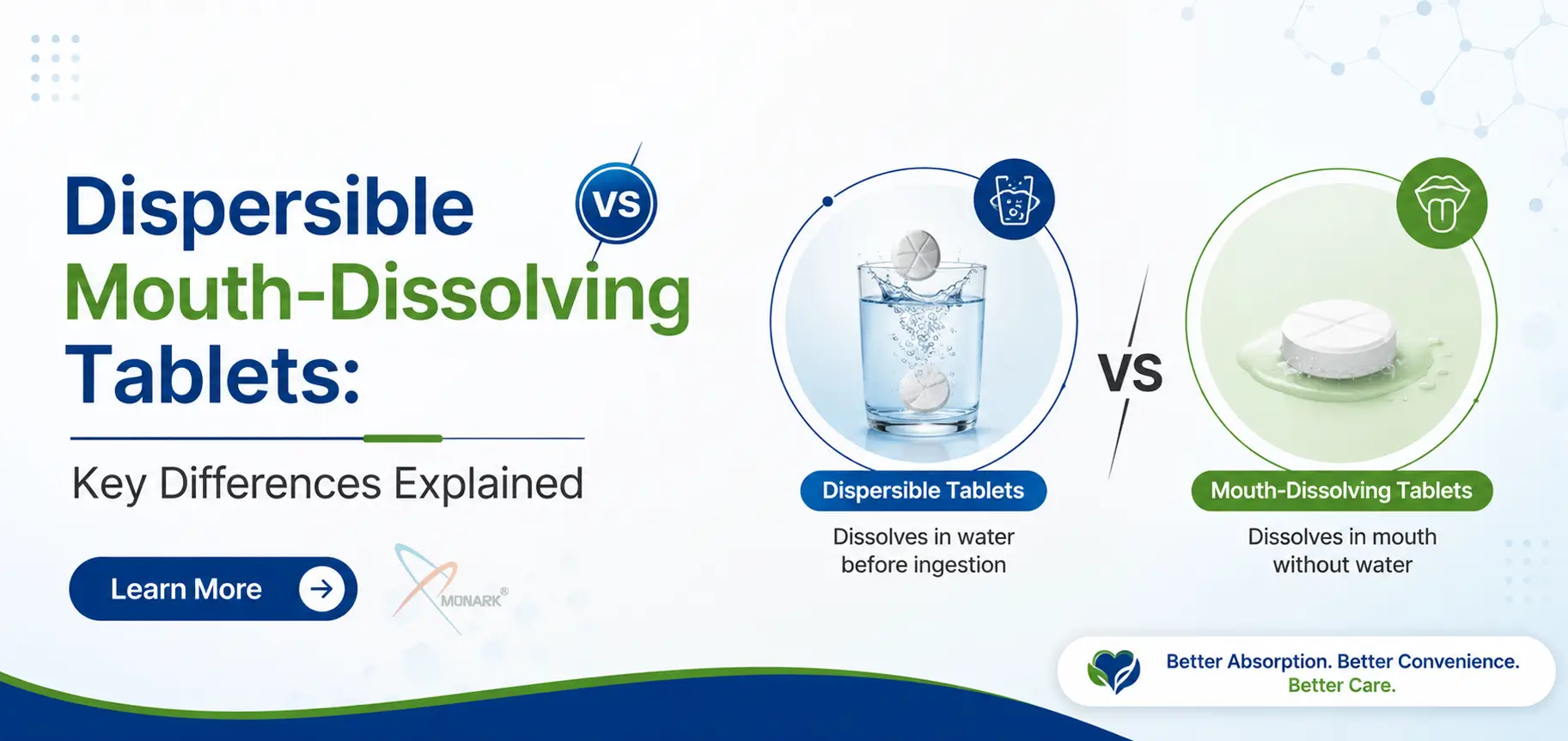
A dispersible tablet is generally designed to be dispersed in a suitable liquid before administration, whereas a mouth-dissolving tablet is formulated to disintegrate in the mouth rapidly. The difference may sound small, but it matters when considering administration, formulation, patient convenience, and pharmaceutical manufacturing.
With so many different types of tablets available today, understanding the purpose behind each dosage form is increasingly important.
In this guide, we'll take a closer look at dispersible vs mouth-dissolving tablets, how they work, where they differ, and how different tablet formulations are used in pharmaceutical products.
Quick Answer: Are Dispersible and Mouth-Dissolving Tablets the Same?
No.
Although both are designed to make oral administration more convenient, they are generally intended to behave differently.
|
Dispersible Tablets |
Mouth-Dissolving Tablets |
|
Designed to disperse in a suitable liquid |
Designed to disintegrate in the mouth |
|
Usually prepared before administration |
Generally taken directly in the mouth |
|
Water is generally used for preparation |
Additional water is generally not required |
|
Focus is on dispersion |
Focus is on rapid oral disintegration |
|
Example: Cefpodoxime dispersible tablets |
Example: Ondansetron mouth-dissolving tablet |
The easiest way to remember it:
Dispersible = disperse it before administration.
Mouth-dissolving = let it disintegrate in the mouth.
What Are Dispersible Tablets?
Dispersible tablets are oral solid dosage forms designed to break apart and disperse in a suitable liquid before administration.
The basic process can be remembered as:
Tablet → Liquid → Dispersion → Administration
The formulation needs to support appropriate dispersion while maintaining the required pharmaceutical quality.
This means that tablet formulation and manufacturing are critical. Developers have to consider factors such as excipient selection, disintegration, stability, tablet strength, manufacturing processes, and packaging.
Why Are Dispersible Tablets Used?
Dispersible formulations can provide an alternative to swallowing an intact conventional tablet.
Depending on the specific medicine and its approved instructions, this type of dosage form may be useful for patients who find conventional tablets difficult to swallow.
Examples of Dispersible Tablets
The Monark Biocare tablet portfolio includes several dispersible formulations.
For example:
These examples show how dispersible dosage forms can be developed for different pharmaceutical applications.
Important: The exact method of preparation and administration should always be based on the specific product's labeling or a healthcare professional's instructions.
What Are Mouth-Dissolving Tablets?
Now let's look at the other side of the comparison.
Mouth-dissolving tablets are designed to rapidly disintegrate in the oral cavity. They are commonly associated with terms such as orally disintegrating tablets (ODTs) and orodispersible tablets.
Their basic journey is:
Tablet → Mouth → Saliva → Rapid Disintegration → Swallowing
Unlike a conventional tablet that is swallowed intact, the formulation is designed to break down in the mouth.
This can provide a convenient option for people who experience difficulty swallowing conventional solid dosage forms or for situations where water may not be readily available.
What Makes Mouth-Dissolving Tablets Different?
The formulation has to strike a delicate balance.
The tablet must be strong enough to withstand manufacturing, packaging, transportation, and handling, but it must also disintegrate rapidly once administered.
Taste can also matter.
Because the dosage form is exposed to the mouth during disintegration, palatability, taste masking, and mouthfeel may become important formulation considerations.
Examples From Monark Biocare
Monark Biocare's product portfolio includes mouth-dissolving and orally disintegrating formulations, including:
The company's tablet listing also identifies these formulations alongside its broader range of pharmaceutical tablets.
Dispersible vs Mouth-Dissolving Tablets: The Real Difference
This is where the distinction becomes much easier.
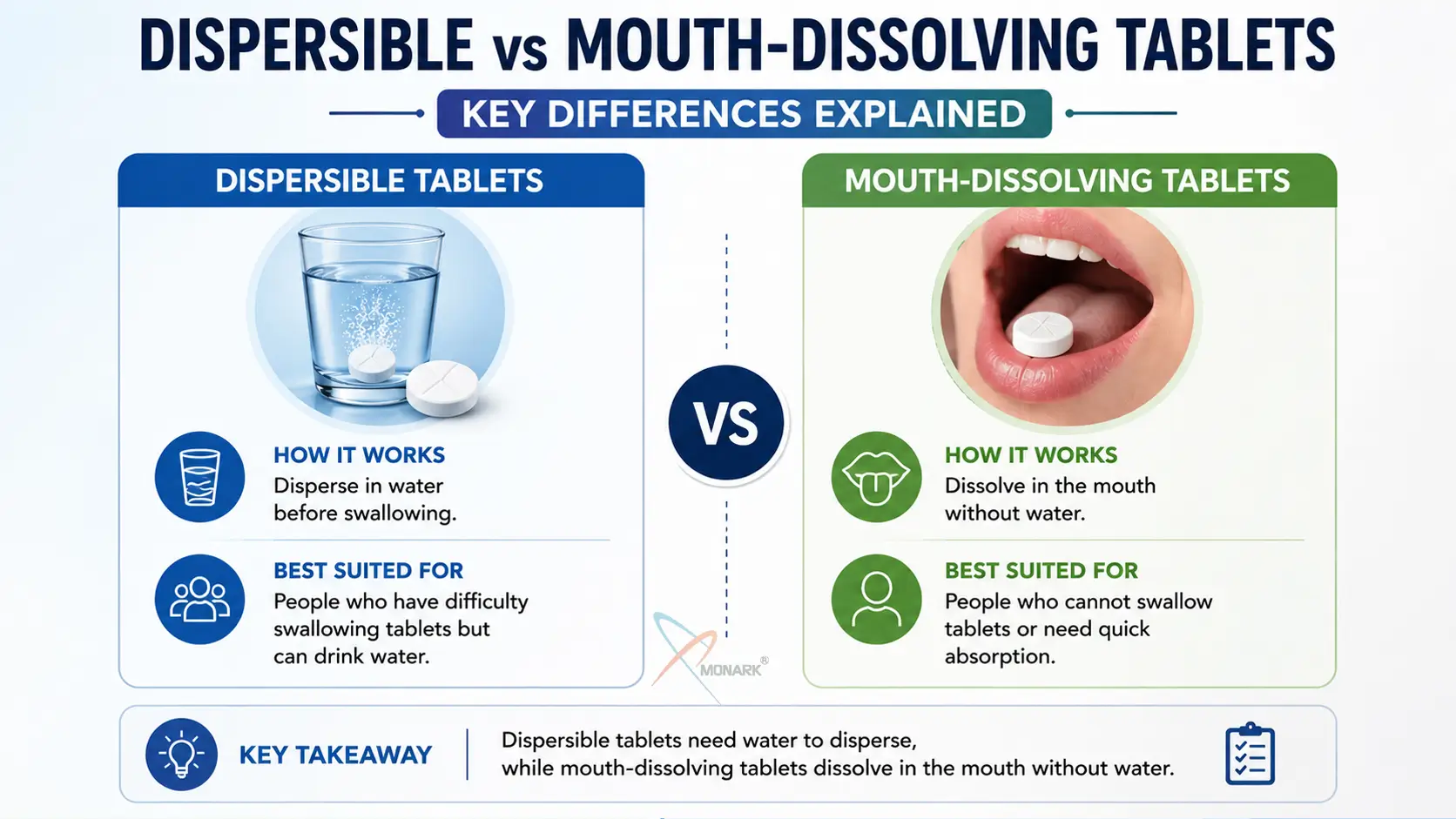
The biggest difference is where and how the tablet is intended to disperse or disintegrate.
|
Feature |
Dispersible Tablets |
Mouth-Dissolving Tablets |
|
Primary purpose |
Dispersion before administration |
Rapid disintegration in the mouth |
|
Typical preparation |
Prepared in a suitable liquid |
Placed directly in mouth |
|
Water requirement |
Generally used for preparation |
Generally not required |
|
Main environment |
Liquid/dispersion medium |
Oral cavity |
|
Common terminology |
Dispersible tablet |
ODT / orodispersible / mouth-dissolving |
|
Formulation priority |
Dispersion and disintegration |
Rapid oral disintegration |
|
Taste considerations |
Relevant |
Often especially important |
|
Patient convenience |
Requires preparation |
Direct oral administration |
|
Example |
Cefpodoxime dispersible tablet |
Ondansetron mouth-dissolving tablet |
What Is the Difference Between Dispersible and Mouth-Dissolving Tablets?
Dispersible tablets are generally designed to be dispersed in a suitable liquid before oral administration, while mouth-dissolving tablets are designed to rapidly disintegrate in the mouth, usually without requiring additional water. The key difference is the intended method and environment of tablet disintegration.
How Do Dispersible Tablets Work?
A dispersible formulation is designed to break apart when placed in an appropriate liquid, creating a dispersion suitable for administration according to the product's instructions.
Several formulation factors can influence this process:
-
Tablet disintegration
-
Wetting characteristics
-
Excipients
-
Particle properties
-
Formulation stability
-
Manufacturing conditions
-
Packaging and storage
This is one reason tablet formulation and manufacturing require careful development.
A formulation cannot simply be designed to disintegrate quickly. It also needs adequate mechanical strength, stability, dose consistency, and manufacturability.
How Do Mouth-Dissolving Tablets Work?
Mouth-dissolving tablets are designed around a different objective: rapid disintegration in the oral cavity.
When the tablet comes into contact with saliva, its formulation is intended to allow it to break down quickly enough for convenient administration.
Important formulation considerations may include:
-
Rapid disintegration
-
Tablet hardness
-
Porosity
-
Moisture sensitivity
-
Taste masking
-
Mouthfeel
-
Stability
-
Packaging
In short, an effective ODT has to perform two jobs:
Survive manufacturing and handling.
Disintegrate efficiently during administration.
That's the formulation challenge.
Why Tablet Formulation Matters More Than You Think
A tablet may look like a simple compressed piece of powder.
Behind that small tablet, however, is a carefully engineered formulation.
The development process can involve decisions about:
-
Active pharmaceutical ingredient
-
Excipients
-
Compression parameters
-
Disintegration characteristics
-
Stability
-
Moisture sensitivity
-
Packaging
-
Manufacturing scalability
-
Quality control
This becomes even more important when developing specialized dosage forms.
For example, the formulation requirements for a dispersible tablet aren't necessarily identical to those for an ODT.
Different dosage forms require different formulation strategies.
Dispersible Tablets: What Are the Advantages?
When appropriately formulated and used according to product instructions, dispersible tablets can offer several practical advantages.
1. An Alternative to Conventional Tablets
They provide another oral dosage-form option for medicines that might otherwise be supplied as conventional tablets.
2. Convenient for Certain Patients
For patients who have difficulty swallowing intact tablets, a prepared dispersion may be easier to administer.
3. Solid-Dosage-Form Convenience
A dispersible tablet can combine characteristics of a solid dosage form with the ability to prepare a dispersion before administration.
4. Broad Formulation Possibilities
The dosage form can be developed for different active pharmaceutical ingredients and therapeutic applications.
Mouth-Dissolving Tablets: Why Are They Popular?
The appeal of mouth-dissolving tablets comes largely from convenience.
1. No Additional Water Is Generally Needed
This can make administration convenient in situations where drinking water isn't immediately available.
2. Rapid Disintegration
The formulation is designed for rapid breakdown in the oral cavity.
3. Useful for Swallowing Difficulties
This dosage form may be useful for people who find conventional tablets difficult to swallow, depending on the medicine and individual circumstances.
4. Convenient Administration
The direct-mouth administration approach can make certain medicines easier to take.
5. Patient Acceptability Can Be Considered
Taste, mouthfeel, and disintegration characteristics can all contribute to the overall experience.
Which Is Better: Dispersible or Mouth-Dissolving?
Here's the answer that matters:
Neither is automatically better.
The appropriate dosage form depends on the medicine, formulation characteristics, patient requirements, administration instructions, and intended use.
Think about it this way:
If the priority is...
Preparing a medicine as a dispersion:
→ A dispersible dosage form may be appropriate.
Direct administration in the mouth:
→ A mouth-dissolving/ODT formulation may be appropriate.
Avoiding additional water:
→ A mouth-dissolving formulation may offer greater convenience.
Creating an alternative to swallowing an intact tablet:
→ A dispersible formulation may be useful.
The final decision should always be based on the specific medicine and its approved instructions.
A Look at Different Types of Tablets
The world of pharmaceutical tablets extends far beyond these two dosage forms.
Depending on the active ingredient and intended therapeutic purpose, manufacturers may develop:
-
Conventional tablets
-
Dispersible tablets
-
Mouth-dissolving tablets
-
Orally disintegrating tablets
-
Chewable tablets
-
Effervescent tablets
-
Enteric-coated tablets
-
Sustained-release tablets
-
Modified-release tablets
Each dosage form has its own formulation and performance requirements.
If you're researching different types of tablets, formulation approaches, and pharmaceutical dosage forms, Monark Biocare or Fedley Healthcare provides a useful place to explore related pharmaceutical topics.
Monark Biocare Tablet Range: Real Examples
One of the easiest ways to understand dosage-form differences is to look at actual products.
Monark Biocare's tablet portfolio includes both conventional and specialized formulations. Its online tablet listing includes dispersible products such as ARPOD-100DT, ARPOD-200DT, CEFILASE-100 DT, and MICFLAM-KT, alongside mouth-dissolving/orally disintegrating products such as FEVISET-MD and LANARK-15 DT.
This provides a practical example of how different formulations can be designed around different administration requirements.
For businesses and pharmaceutical professionals exploring tablet products, understanding the distinction between dosage forms is useful when evaluating product portfolios, formulation strategies, and manufacturing capabilities.
Dispersible vs Mouth-Dissolving Tablets: 10-Second Recap
|
Remember This |
Dispersible |
Mouth-Dissolving |
|
Where? |
Suitable liquid |
Mouth |
|
Preparation? |
Generally yes |
Generally no |
|
Water? |
Generally used |
Generally unnecessary |
|
Key process? |
Dispersion |
Oral disintegration |
|
Common term? |
Dispersible tablet |
ODT / orodispersible |
|
Main attraction? |
Prepared dispersion |
Convenient direct administration |
The easiest memory trick:
Dispersible → Think WATER.
Mouth-dissolving → Think MOUTH.
From Tablet Knowledge to Pharma Growth
Knowing the difference between dispersible and mouth-dissolving tablets is useful. Knowing how to turn the right pharmaceutical product into a business opportunity is even better.
Looking to take the next step?
|
Your Goal |
Explore |
|
Manufacture Your Own Brand |
|
|
Start or Expand Your Pharma Business |
|
|
Build Product Visibility |
|
|
Enter International Markets |
|
|
Find End-to-End Pharma Support |
Whether you’re launching a new product, expanding your existing portfolio, strengthening brand promotion, or exploring overseas markets, the right pharmaceutical partner can help turn an idea into a market opportunity.
One Product. Multiple Possibilities.
Manufacture it. Promote it. Distribute it. Export it. Grow with it.
📍 Visit Us
Plot No. 201, HSIIDC, Alipur, Barwala, Haryana, India
📲 Talk to Our Team
+91-9855986633 | +91-9023256719 | +91-9888656719
✉ monarkbiocare@gmail.com
Have a product, manufacturing, franchise, or export requirement? Connect with Monark Biocare and explore the right pharma solution for your business.
Final Takeaway
Dispersible tablets and mouth-dissolving tablets may look similar, but their intended use is different.
A dispersible tablet is generally designed to be dispersed in a suitable liquid before administration.
A mouth-dissolving tablet is designed to rapidly disintegrate directly in the mouth.
Understanding this distinction is useful not only for patients and healthcare professionals but also for pharmaceutical companies involved in tablet formulation and manufacturing.
And when you're exploring different types of tablets, real product examples make the concept much easier to understand. Monark Biocare's tablet portfolio demonstrates the availability of both dispersible and mouth-dissolving/orally disintegrating formulations across its product range.
Frequently Asked Questions
01. Are dispersible tablets and mouth-dissolving tablets the same?
No. Although both are designed to facilitate oral administration, dispersible tablets are generally intended to be dispersed in a suitable liquid, while mouth-dissolving tablets are designed to disintegrate in the mouth rapidly.
02. Do mouth-dissolving tablets require water?
Generally, they are designed to be administered without additional water. However, always follow the instructions provided with the individual medicine.
03. What are dispersible tablets?
Dispersible tablets are oral solid dosage forms designed to disperse in a suitable liquid before administration.
04. What are mouth-dissolving tablets?
Mouth-dissolving tablets are designed to rapidly disintegrate in the oral cavity. They are commonly associated with ODTs and orodispersible tablets.
05. What does ODT stand for?
ODT stands for orally disintegrating tablet.
06. Are ODT and mouth-dissolving tablets the same?
They are closely related terms for dosage forms designed to disintegrate rapidly in the mouth, although terminology can vary depending on the product and regulatory context.
07. Which is easier to take?
It depends on the individual and the specific medicine. Dispersible tablets generally require preparation before administration, while mouth-dissolving tablets are generally designed for direct administration in the mouth.
08. Why is taste important in mouth-dissolving tablets?
Because the tablet is exposed to the mouth during disintegration, taste and mouthfeel can influence patient acceptability.
09. What is important in tablet formulation?
Factors can include the active pharmaceutical ingredient, excipient selection, disintegration behavior, tablet strength, stability, manufacturing process, packaging, and patient acceptability.
Disclaimer: Knowledge empowers better choices, but it never replaces expert medical advice. This article is for general education only and does not recommend self-medication. Product composition, usage, and suitability may differ. Always read the label and consult a qualified healthcare professional before taking any medicine.