
18th August 2026 | By Admin
How to Export Medicines from India: A Step-by-Step Guide for International Buyers
Exporting medicines from India involves navigating two distinct regulatory frameworks: India's export requirements (governed by DGFT, CDSCO, and Customs) and the importing country's own pharmaceutical regulations. International buyers must verify supplier credentials, confirm product registration status, and secure the correct documentation before placing an order. This guide walks through the complete process, step by step.
India is one of the world's most significant pharmaceutical suppliers. According to Pharmexcil (the Pharmaceuticals Export Promotion Council of India), India's pharma exports have grown from USD 15.44 billion in FY2014 to USD 31.11 billion in FY2026, more than doubling in a decade. The country supplies 65–70% of WHO's essential immunisation vaccines globally, and 10 of the top 25 global generic medicines originate from Indian manufacturers.
For international buyers – whether you are a pharmaceutical importer, distributor, procurement manager, or healthcare company – India represents a compelling sourcing opportunity. But the path from initial inquiry to final shipment is multi-layered and one that requires careful navigation of regulatory, commercial, and logistical requirements.
From a pharma exporter's perspective, the buyers who succeed approach the process systematically. Those who don't often encounter delays or rejected shipments or, worse, fall victim to fraudulent suppliers. This guide is designed to prevent exactly that.
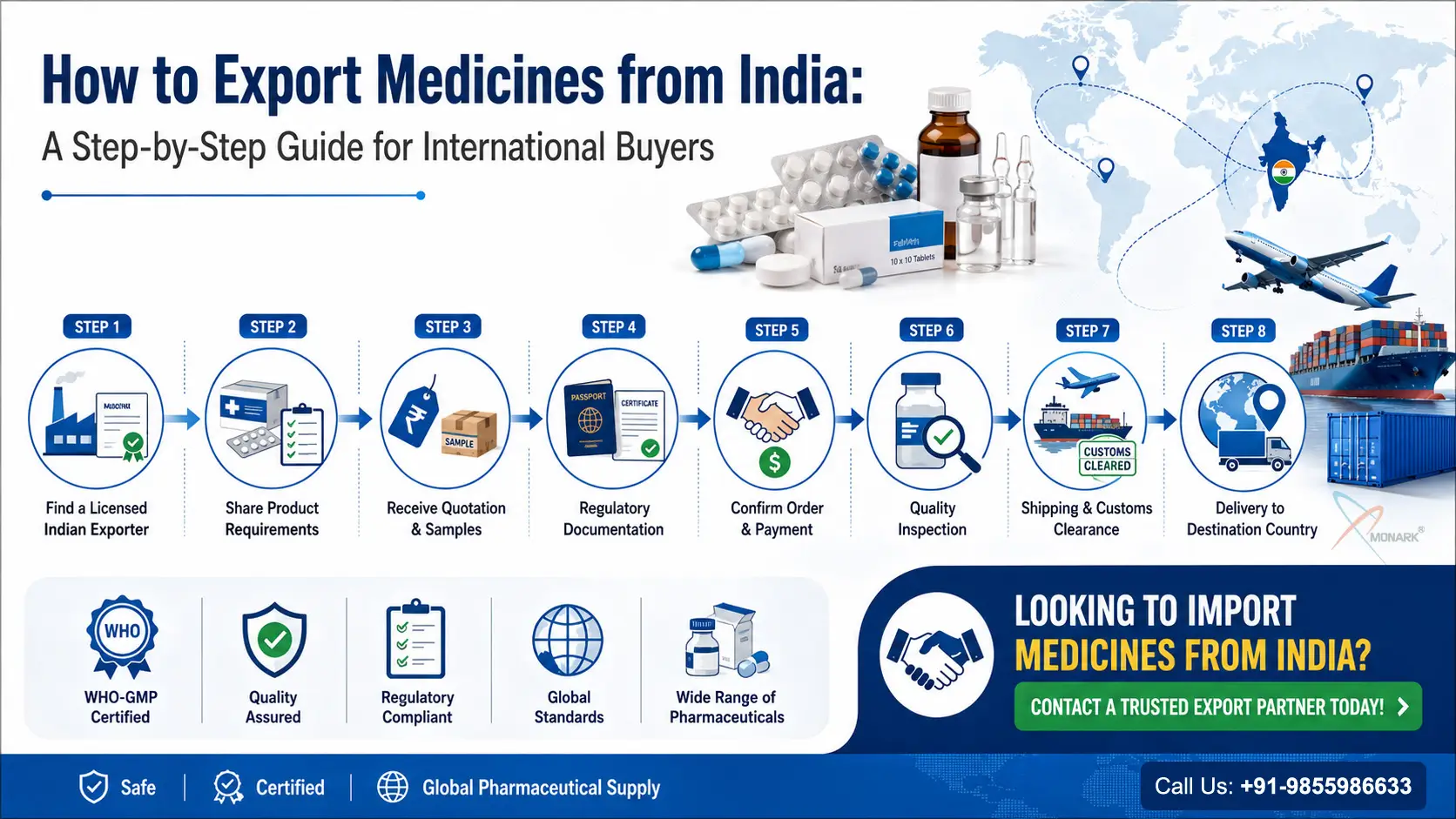
To export medicines from India, first select a licensed pharmaceutical supplier, verify the product and destination-country requirements, complete the required importer/exporter documentation, agree on commercial terms, prepare regulatory and shipping documents, and arrange compliant pharmaceutical transportation and customs clearance.
Important: Pharmaceutical export requirements vary by medicine and destination country. Buyers should verify current requirements with the relevant Indian authorities and the pharmaceutical regulatory authority in the importing country before placing an order.
Step 1: Understand the Pharmaceutical Import Requirements of Your Country
Before you contact a single Indian supplier, you must understand what your own country requires. This is a responsibility that falls entirely on the importer or buyer.
Every destination country has its own National Regulatory Authority (NRA). The US FDA governs pharmaceutical imports into the United States; the EMA oversees Europe; the UK MHRA regulates the United Kingdom; and so on. Each authority sets its own rules on product registration, permitted dosage forms, labelling standards, controlled substances, and documentation requirements.
For an international buyer, the important point is this: Indian export regulations and your country's import regulations are separate frameworks. Compliance with Indian export law does not automatically mean compliance with your country's import law.
Always consult your country's NRA before initiating procurement. Confirm:
-
Whether the specific product (by INN, strength, dosage form, and pack size) is permitted for import
-
Whether it requires prior registration or marketing authorization in your country
-
What documentation your customs or regulatory authority will require at the port of entry
Read also - Top International Markets for Medicines Exported from India
Step 2: Identify the Medicines You Want to Import
Pharmaceutical products are not generic commodities. The regulatory and commercial requirements differ significantly based on:
-
Active Pharmaceutical Ingredient (API): Is the molecule a controlled substance under your country's law or under international narcotics conventions?
-
Dosage form: Tablets, injectables, biologicals, and vaccines each carry different requirements
-
Intended use: Human use, veterinary, research, or re-export?
-
Registration status: Is the product approved in India, in your country, or in both?
Identify the ITC (HS) code of the product. India's export documentation, including the shipping bill filed at ICEGATE (icegate.gov.in), requires the correct HS code classification.
Step 3: Find a Reliable Indian Pharmaceutical Manufacturer or Exporter
India has thousands of pharmaceutical manufacturers and trading companies. Not all are equal in terms of quality standards, regulatory compliance, or export experience.
Reliable sources for identifying legitimate Indian pharma exporters include:
-
Pharmexcil (pharmexcil.com): The Government of India's authorised export promotion council for pharmaceuticals. Pharmexcil maintains a directory of registered member exporters and publishes trade enquiries from international buyers
-
CDSCO (cdsco.gov.in): The Central Drugs Standard Control Organisation maintains records of licensed manufacturers
-
International pharma trade fairs: iPHEX (organized by Pharmexcil), CPHI Worldwide, and similar events are attended by verified Indian pharma exporters
One area that is often overlooked is the distinction between a manufacturer and a trading company. A manufacturer produces the product directly; a trading company sources from manufacturers. Both can export legally, but your due diligence approach will differ.
Step 4: Verify the Indian Pharmaceutical Supplier — Due Diligence Checklist
In our industry, buyers should evaluate every potential Indian supplier against the following criteria before engaging commercially:
-
Valid drug manufacturing licence issued by the respective State Drugs Controller
-
GMP Certification: WHO-GMP, EU-GMP, or US FDA approval (depending on your market)
-
Valid IEC (Importer-Exporter Code): Every Indian exporter must hold a valid IEC issued by the Directorate General of Foreign Trade (DGFT, dgft.gov.in). Without a valid IEC, an entity cannot legally export from India
-
Pharmexcil RCMC (Registration cum Membership Certificate): Confirms the exporter is registered with the authorized pharmaceutical export promotion council
-
Product portfolio and technical dossiers: Can the supplier provide full regulatory documentation for the specific product you require?
-
Track record: References from existing international customers; verifiable export history
Do not rely solely on brochures or websites. Request copies of licenses and verify them directly with the issuing authority where possible.
Step 5: Confirm Product Quality and Regulatory Documentation
Quality documentation is central to pharmaceutical exports. Key documents you should request from any Indian supplier include:
-
Certificate of Analysis (CoA): Confirms the product meets specification; issued for each batch
-
Certificate of Pharmaceutical Product (CPP): Issued by CDSCO on behalf of the Indian government; certifies that the product is manufactured and marketed in India in accordance with national requirements. Buyers in many countries require a CPP for product registration
-
GMP Certificate: Issued by the State Licensing Authority or CDSCO; confirms the manufacturing site meets Good Manufacturing Practice standards
-
Stability data: Especially important for products with temperature-sensitive shelf lives
The CoA should reference a pharmacopoeial standard (IP, BP, USP, or EP) or an in-house specification that meets regulatory requirements. Always verify that the CoA corresponds to the specific batch being supplied.
Step 6: Check Whether the Product Is Registered in the Destination Country
This step is often the most time-consuming and the most consequential. A product can be legally manufactured and exported from India but still require formal registration or marketing authorisation in your country before it can be sold or distributed.
Product registration requirements vary enormously. Some countries accept a WHO prequalified product without additional registration. Others require full dossier submissions that can take one to three years to complete. Certain markets allow importation under a Named Patient Program or Special Access Scheme without full registration.
Understand your country's pathway before finalising any supply agreement. This is your responsibility as the importer, not the Indian exporter's.
Step 7: Request a Quotation From the Indian Supplier
Once you have shortlisted a verified supplier and confirmed regulatory feasibility, request a formal quotation. A proper pharmaceutical export quotation should include:
-
Product name, INN, strength, dosage form
-
Pack size and configuration
-
Unit price, currency, and validity period
-
Minimum Order Quantity (MOQ)
-
Lead time for manufacturing and dispatch
-
Incoterms (e.g., EXW, FOB, CIF, CIP)
-
Payment terms
-
Regulatory documents available (CoA, CPP, GMP certificate)
Step 8: Evaluate Price, MOQ, Payment Terms, and Incoterms
From a pharma exporter's perspective, the commercial terms of a pharmaceutical transaction carry significant regulatory implications that buyers sometimes underestimate.
MOQ (Minimum Order Quantity): Indian manufacturers set MOQs based on batch size requirements tied to GMP protocols. For regulated markets, a batch may run to tens of thousands of units. For semi-regulated markets, smaller quantities are sometimes available, particularly from trading companies.
Incoterms: The choice of Incoterm determines who is responsible for freight, insurance, customs clearance, and risk of loss. CIF (Cost, Insurance, and Freight) transfers risk at the destination port; FOB (Free on Board) places logistics responsibility on the buyer from the Indian port of loading. Choose the Incoterm that matches your logistics capability and risk tolerance.
Payment terms: Standard pharmaceutical export transactions often involve advance payment (T/T), Letters of Credit (L/C), or Documentary Collections (D/P or D/A). Letters of Credit are strongly recommended for first-time transactions with new suppliers.
Step 9: Approve Artwork, Packaging, and Labeling
Pharmaceutical labelling is regulatory by nature. Your destination country's NRA will specify labelling requirements, language, mandatory statements, shelf-life display format, storage conditions, and more. Many countries require that the importer's name and address appear on the label.
Work with your Indian supplier to finalise artwork before manufacturing begins. Changes to artwork after batch manufacture are not possible under GMP protocols. Delays at this stage are common and preventable with early attention.
Step 10: Place the Purchase Order
A Purchase Order (PO) for pharmaceutical products should be a formal written document clearly specifying the following:
-
Product description, strength, dosage form, pack configuration
-
Quantity ordered
-
Agreed price and currency
-
Incoterms and delivery destination
-
Required delivery date
-
Quality specifications and applicable pharmacopoeial standards
-
Documentation requirements (CoA, CPP, GMP certificate, etc.)
-
Payment terms
Both parties should sign and retain a copy. The PO forms the contractual basis for the transaction and supports subsequent export documentation.
Step 11: Manufacturing, Quality Control, and Batch Release
For custom or to-order products, manufacturing begins after PO acceptance. For stock products, the supplier may be drawing from existing inventory.
Every batch must undergo full quality control testing before release. This includes in-process controls, finished product testing, and final CoA generation. Under GMP protocols, a qualified person (or equivalent) must authorise batch release before the product can leave the manufacturing site.
Do not accept assurances that testing "will be done" after shipment. Batch release is a pre-shipment requirement.
Step 12: Prepare Export and Shipping Documentation
This is where Indian export regulatory requirements come into direct focus. According to DGFT (dgft.gov.in) and as confirmed under Pharmexcil/DGFT Public Notice No. 114, the mandatory export documents for all shipments from India are the following:
-
Shipping Bill / Bill of Export: Filed electronically through ICEGATE (icegate.gov.in); the primary customs export document
-
Commercial Invoice cum Packing List: Details the transaction value, quantities, and packaging
-
Bill of Lading / Airway Bill: Issued by the carrier; confirms shipment and serves as the document of title
In addition to these mandatory documents, pharmaceutical-specific documentation is required depending on the product and destination:
-
Certificate of Analysis (CoA): Almost universally required by importing authorities
-
Certificate of Pharmaceutical Product (CPP): Required for product registration and importation in many countries; issued by CDSCO
-
GMP Certificate: Required by regulated markets
-
Export NOC from CDSCO: Required for certain categories of medicines, specifically unapproved drugs, banned drugs, and new drugs that are not approved in India. CDSCO Zonal Offices handle these NOC applications centrally. For NDPS (Narcotic Drugs and Psychotropic Substances) drugs, the NOC is specific to the quantity and purchase order
-
Certificate of Origin: May be required by the importing country's customs for duty purposes; issued through Pharmexcil or authorized agencies
The exporter is responsible for ensuring all documentation is accurate, complete, and consistent across all documents. Discrepancies between the commercial invoice, packing list, and shipping bill are a common cause of customs delays.
Step 13: Customs Clearance and Shipment
On the Indian side, the Shipping Bill is filed with Indian Customs through ICEGATE. Once a Licence for Export Order (LEO) is granted, the goods can be loaded and dispatched.
On the destination country side, the buyer or their customs broker must file the import declaration and present all required documentation to the importing authority. Depending on the product and country, pharmaceutical imports may be subject to:
-
Random sampling and testing by the NRA
-
Port health authority inspection
-
Temperature and storage condition verification (for cold chain products)
Ensure your freight forwarder and customs broker at the destination are experienced in pharmaceutical import clearance.
Step 14: Receive and Inspect the Shipment
On receipt, the buyer must conduct a physical inspection of the shipment against the Packing List and Purchase Order. Check for:
-
Correct product, strength, and quantity
-
Intact packaging and seals
-
Absence of damage or temperature excursion (for cold chain products)
-
Expiry date and remaining shelf life (confirm this meets your market requirements before ordering)
-
Batch numbers matching the CoA and other documents
Any discrepancy should be reported to the Indian supplier immediately and documented in writing. Do not distribute product until all documentation has been reviewed and confirmed accurate.
How Long Does It Take to Export Medicines from India?
The timeline varies considerably depending on product type, regulatory requirements, and whether the product is in stock or manufactured to order.
|
Stage |
Typical Timeframe |
|
Supplier identification and due diligence |
2–8 weeks |
|
Quotation, negotiation, and PO |
1–3 weeks |
|
Artwork/labeling approval |
1–4 weeks |
|
Manufacturing (to-order products) |
4–12 weeks |
|
Quality control and batch release |
1–3 weeks |
|
Export documentation and customs |
1–2 weeks |
|
Shipping (sea freight) |
2–6 weeks (varies by destination) |
|
Total (manufactured to order) |
12–36 weeks |
Stock products can ship significantly faster, sometimes within 4–8 weeks of PO placement. Regulated market products requiring CDSCO NOCs, CPPs, or destination-country registration may take considerably longer.
How Much Does It Cost to Import Medicines from India?
Cost depends on the product, quantity, dosage form, origin manufacturer's certifications, and destination. Variables include:
-
Product cost: Generics sourced from WHO-GMP certified facilities are priced differently from EU-GMP or US FDA-approved manufacturers
-
Freight and insurance: Air freight is significantly more expensive than sea freight; cold chain logistics carry a premium
-
Import duties and taxes: Set by your country's customs authority; pharmaceuticals may attract zero or reduced duty under bilateral or multilateral trade agreements
-
Regulatory costs: CPP applications, product registration fees, and customs broker fees are additional
There is no single answer to "how much does it cost?" Any supplier who quotes you a price without understanding your destination market, pack configuration, and required documentation should be treated with caution.
How to Avoid Pharma Export Scams
One area that is often overlooked by first-time international buyers is the risk of fraudulent suppliers. DGFT has explicitly warned trade about unauthorized websites and individuals misrepresenting themselves as legitimate exporters.
Protect yourself by:
-
Verifying the supplier's IEC against the DGFT database (dgft.gov.in)
-
Confirming the Drug Manufacturing License with the State Drugs Controller
-
Verifying GMP certification directly with the issuing authority (CDSCO or State Licensing Authority)
-
Never making advance payments to unverified suppliers without a Letter of Credit or verifiable banking reference
-
Checking Pharmexcil's member directory (pharmexcil.com) to confirm membership status
-
Avoiding suppliers who cannot provide verifiable references from existing international customers
If a supplier cannot provide copies of their IEC, Drug License, and GMP certificate or if they are unwilling to allow a factory audit, treat this as a serious red flag.
Questions International Buyers Should Ask an Indian Pharma Supplier
Before moving forward with any supplier, ask:
-
What is your IEC number, and can I verify it with DGFT?
-
Which Drug Manufacturing License covers this product, and who issued it?
-
What GMP certifications does your facility hold, and when were they last audited?
-
Is this product approved for sale in India? If not, is a CDSCO Export NOC required?
-
Can you provide a CPP for this product for registration purposes in my country?
-
What is your standard batch size, and can you accommodate smaller orders?
-
What are your standard payment terms for first-time international buyers?
-
Have you previously exported to my country or region? Can you provide references?
-
What is the remaining shelf life at the time of shipment?
-
Can you provide a sample for testing before we place a commercial order?
Common Mistakes International Buyers Make
From years of working with international buyers across multiple markets, these are the most common and costly mistakes:
-
Confusing Indian export approval with destination-country import approval: The two are entirely separate. A product can be legally exported from India but still require registration or a license to import in your country
-
Skipping supplier verification: Due diligence is not optional in pharmaceutical procurement
-
Neglecting to confirm shelf life: Products must have sufficient remaining shelf life not just for import clearance, but for distribution, sale, and consumption
-
Underestimating lead times: Pharmaceutical manufacturing and documentation take time. Urgent orders often result in errors or, worse, pressure on the supplier to cut corners
-
Selecting suppliers on price alone: GMP compliance, documentation quality, and regulatory experience matter far more than unit price in the long run
-
Not specifying labeling requirements at the outset: Last-minute label changes cause delays and additional costs
-
Ignoring cold chain requirements: Temperature-sensitive products must be shipped and received under validated cold chain conditions. Failure to plan for this results in product loss
India Pharma Export Process — Quick Checklist
Buyer's pre-order checklist:
-
Confirm product is importable in your country
-
Identify and verify at least 2–3 potential suppliers
-
Confirm IEC, Drug License, and GMP certifications of shortlisted suppliers
-
Request and review product dossier, CoA, and CPP availability
-
Confirm shelf life requirements and cold chain needs
-
Agree on Incoterms, payment terms, and MOQ
-
Finalize and approve artwork/labeling before manufacturing
Pre-shipment checklist:
-
Batch CoA received and reviewed
-
All export documents prepared (Shipping Bill, Commercial Invoice cum Packing List, Bill of Lading/Airway Bill)
-
Pharma-specific documents secured (CPP, GMP certificate, CDSCO Export NOC if required)
-
Import clearance arrangements confirmed with destination customs broker
-
Cold chain logistics confirmed (if applicable)
Post-shipment checklist:
-
Shipment tracked to destination
-
Physical inspection conducted on receipt
-
All documents archived for regulatory purposes
Make Your India Pharma Sourcing Process Work
The pharmaceutical export process from India is navigable, but it rewards preparation, diligence, and informed decision-making. Buyers who understand the regulatory landscape, verify their suppliers thoroughly, and invest time in proper documentation consistently achieve better outcomes: fewer delays, fewer compliance issues, and stronger long-term supplier relationships.
If you are an international buyer looking to source pharmaceutical products from India and would like to discuss your specific requirements, request product information, or understand the regulatory documentation applicable to your market, we welcome genuine inquiries from qualified buyers. Reach out to discuss your sourcing needs [Contact Us].
Frequently Asked Questions
Q1. What regulatory authority oversees pharmaceutical exports from India?
Pharmaceutical exports from India involve multiple authorities. The DGFT (Directorate General of Foreign Trade, dgft.gov.in) governs export policy and IEC issuance. CDSCO (cdsco.gov.in) regulates drug quality and issues Export NOCs for certain product categories and CPPs. Indian Customs (operating through ICEGATE, icegate.gov.in) handles the Shipping Bill and customs clearance. Pharmexcil (pharmexcil.com) is the Government of India's authorized export promotion council for pharmaceuticals.
Q2. What is an IEC, and why is it mandatory for pharmaceutical exports from India?
An Importer-Exporter Code (IEC) is a unique business identification number issued by DGFT (dgft.gov.in). It is mandatory for all exports from India. No person or entity can legally export pharmaceutical products or any goods from India without a valid IEC. International buyers should verify a supplier's IEC through the DGFT portal before engaging commercially.
Q3. When is a CDSCO Export NOC required for pharmaceutical exports from India?
CDSCO issues Export NOCs for unapproved drugs, banned drugs, and new drugs not approved in India. These NOCs are processed centrally through CDSCO Zonal Offices. For NDPS (Narcotic Drugs and Psychotropic Substances), the Export NOC is specific to the quantity and purchase order. Not all pharmaceutical products require a CDSCO Export NOC; standard approved generics exported for permitted markets typically do not.
Q4. What is a Certificate of Pharmaceutical Product (CPP), and who issues it?
A CPP is a document issued by CDSCO on behalf of the Government of India. It certifies that a specific pharmaceutical product is manufactured and sold in India in conformity with national requirements. Many countries require a CPP as part of the product registration or import clearance process. International buyers should request a CPP from their Indian supplier at the time of order placement.
Q5. What are the mandatory export documents for pharmaceutical shipments from India?
As per DGFT (and confirmed under Pharmexcil/DGFT Public Notice No. 114), the three mandatory export documents for all shipments from India are: (1) Shipping Bill / Bill of Export, (2) Commercial Invoice cum Packing List, and (3) Bill of Lading / Airway Bill. Pharma-specific documents- CoA, CPP, GMP certificates, and CDSCO Export NOC (where required) are additional requirements based on the product type and destination country.
Q6. How do I verify whether an Indian pharmaceutical supplier is legitimate?
Verify the supplier's IEC through DGFT (dgft.gov.in), confirm the Drug Manufacturing License with the State Drugs Controller, verify GMP certification through CDSCO or the relevant State Licensing Authority, and check Pharmexcil membership at pharmexcil.com. Always request verifiable references from existing international customers and, where possible, conduct a virtual or in-person factory audit.
Q7. Does Indian pharmaceutical export approval mean the product is automatically cleared for import in my country?
No. Indian export compliance and destination-country import compliance are entirely separate regulatory frameworks. A product may be legally exported from India but still require marketing authorization, product registration, or an import license in your country. Buyers must consult their country's National Regulatory Authority before initiating procurement.
Q8. What is Pharmexcil, and how does it help international buyers?
Pharmexcil (pharmexcil.com) is the Pharmaceuticals Export Promotion Council of India, the Government of India's authorized agency for promoting pharmaceutical exports. Pharmexcil maintains a directory of registered Indian pharmaceutical exporters, publishes market and regulatory information, facilitates trade enquiries, and issues Certificates of Origin and RCMC. International buyers can use Pharmexcil's trade enquiry platform to connect with verified member exporters.
Disclaimer
This guide is intended for general informational purposes only and should not be considered legal, medical, regulatory, or commercial advice. Pharmaceutical export requirements may vary depending on the medicine, destination country, applicable regulations, and current government policies. International buyers and exporters should independently verify licensing, product registration, import permissions, labeling requirements, customs procedures, documentation, and compliance obligations before initiating any transaction. Always consult qualified regulatory, legal, and trade professionals to ensure compliance with applicable Indian and international pharmaceutical export regulations.