
29th August 2026 | By Admin
Top Countries Importing Medicines from India: A Pharma Exporter’s Global Market Guide
India makes the medicines. The world is buying. But where should an exporter look first?
That is the real question.
The global pharmaceutical trade has opened remarkable opportunities for Indian manufacturers and exporters. From pharmaceutical tablets and pharmaceutical capsules to injectables, syrups, antibiotics, anti-malarials, and gastroenterology products, Indian pharmaceutical businesses serve healthcare markets far beyond the domestic market.
But international expansion isn't simply about putting a product in a shipping container.
An exporter needs to know which countries import medicines from India, what those markets demand, what regulatory hurdles may exist, and where a particular product portfolio has the strongest commercial fit.
This guide takes you beyond a simple country list. We'll look at the major pharmaceutical export markets, the products India supplies globally, how exporters can evaluate new destinations, and how the right manufacturing partner can support long-term growth.
Which Countries Import Medicines From India?
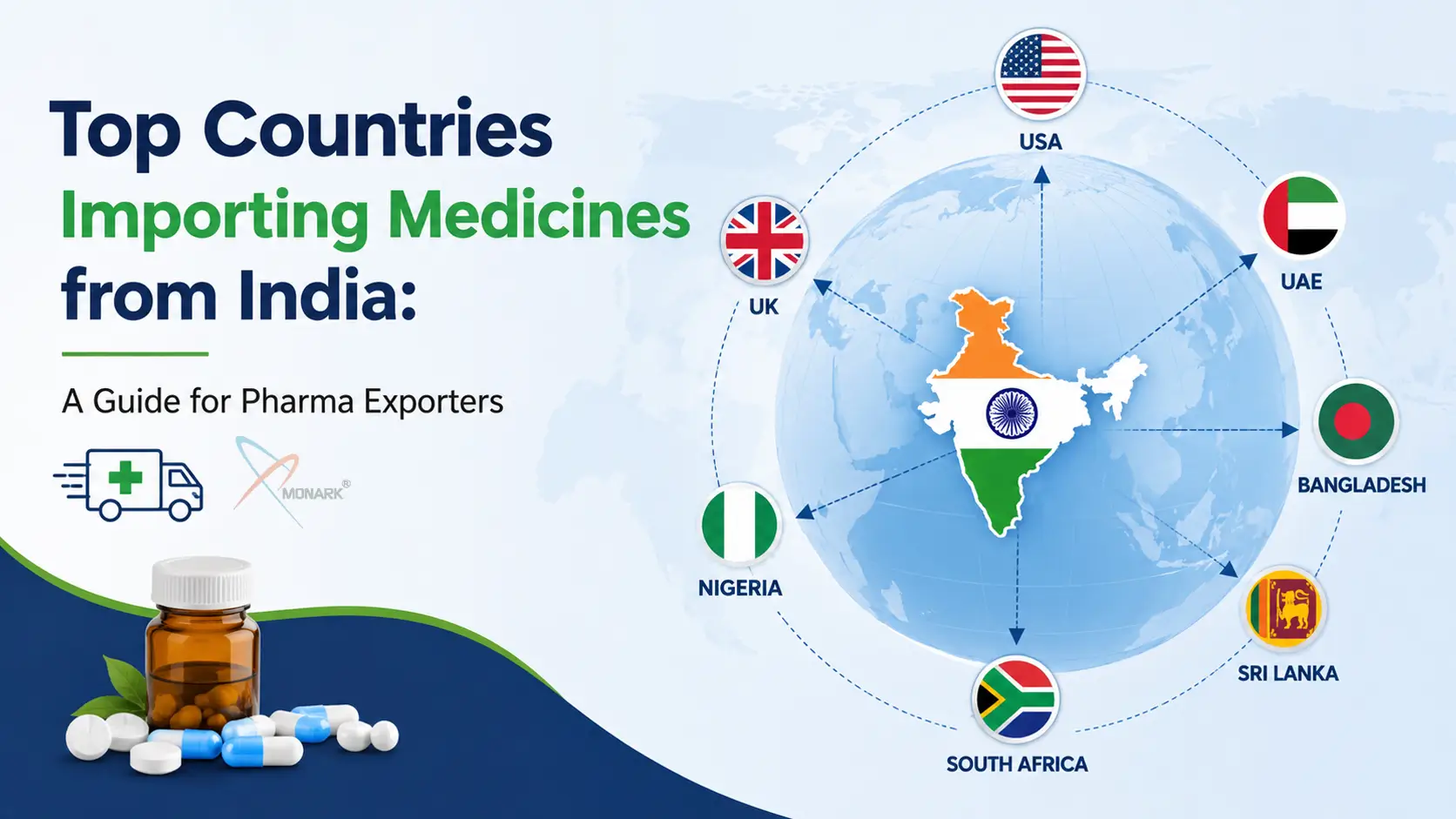
Major countries importing pharmaceutical products from India include the United States, United Kingdom, South Africa, Brazil, France, Canada, and Nigeria. The USA is one of India's largest pharmaceutical export destinations, while European, African, and Latin American markets also provide opportunities for Indian pharmaceutical exporters.
India’s Pharma Export Engine Has Hit a New Gear
India’s pharmaceutical export story is moving from “Made in India” to “Trusted Around the World.” The latest Government of India data shows that India exported approximately US$35.8 billion in pharmaceutical and API products during FY 2025–26, while global pharmaceutical and API demand was estimated at around US$1.3 trillion in 2025.
|
Pharma Export Indicator |
🇮🇳 Latest Data |
|
Pharmaceutical & API exports, FY 2025–26 |
US$35.8 Billion |
|
Global pharma & API demand, 2025 |
~US$1.3 Trillion |
|
Countries reached, FY 2024–25 |
191 Countries |
|
Pharma exports, FY 2024–25 |
US$30.5 Billion |
|
Global ranking by pharma export value |
11th |
|
Exports to highly regulated markets |
~50% |
|
Long-term export ambition |
US$50 Billion by 2030 |
The numbers tell an important story for pharma exporters in India. India is not relying solely on emerging markets; government data shows that around 50% of pharmaceutical exports went to highly regulated markets such as the US and Europe in FY 2024–25. At the same time, Indian exporters are diversifying into markets including Nigeria, Mexico, Tanzania, the Netherlands, France, Brazil, Sri Lanka, Saudi Arabia, and Spain.
Read also - Finding International Buyers for Indian Medicines
What does this mean for exporters?
The opportunity is bigger than simply asking “Which countries import medicines from India?”
It is about finding the right product + right market + right partner.
With India targeting approximately US$50 billion in pharmaceutical exports by 2030, businesses exploring pharmaceutical exports from India, generic medicines from India, and international pharmaceutical supply opportunities have a growing global market to evaluate.
Latest official sources: Government of India – June 2026 pharma trade update · Government of India – March 2026 pharmaceutical sector update
One Country Isn't the Opportunity. The World Is.
When people talk about pharmaceutical exports from India, the conversation often starts with the United States.
And for good reason.
But India's pharmaceutical export story is much bigger.
Indian medicines and pharmaceutical products reach markets across North America, Europe, Africa, Latin America, Asia, and other regions.
That creates an important opportunity for pharma exporters in India:
Don't build your export strategy around one country. Build it around the right markets for your products.
A strong export strategy considers demand, regulations, competition, pricing, distribution, logistics, and long-term growth potential.
The global opportunity, simplified:
Established markets → USA, UK, France, Canada
Growing opportunities → South Africa, Nigeria, Brazil, and other emerging markets
The smart move → Match the product to the market.
The Global Buyer Map: Where Are Indian Medicines Going?
There isn't a single “best” country for every pharmaceutical exporter.
A generic medicine manufacturer may see an opportunity in one market, while a business specializing in injectables or a particular therapeutic segment may find another market more suitable.
Still, several countries consistently stand out when discussing Indian pharmaceutical exports.
USA — The Market Everyone Watches
Why does the USA matter?
Because it is one of the most important destinations for pharmaceutical exports from India.
Indian pharmaceutical companies have developed significant capabilities in generic medicines and pharmaceutical formulations, creating an established relationship with the US healthcare supply chain.
What makes the market attractive?
-
Strong pharmaceutical demand
-
Significant generic medicine opportunities
-
Large healthcare ecosystem
-
Established distribution networks
-
Potential for long-term commercial relationships
But here's the catch:
Opportunity is high. Regulation is serious.
Companies targeting the US need to understand applicable regulatory requirements, product registration, manufacturing standards, documentation, labeling, and quality expectations.
Exporter takeaway:
Don't enter the US market because it's big. Enter only when your product, compliance systems, documentation, and supply capabilities are ready.
UK — A European Market With Strategic Value
The UK is another important destination for pharma exporters in India.
Its established healthcare system and pharmaceutical market can provide opportunities for companies offering suitable products and maintaining strong quality and regulatory systems.
But successful market entry requires preparation.
Before approaching buyers, exporters should understand the requirements applicable to their products, including registration, labeling, documentation, quality, and import procedures.
The exporter mindset:
Product first. Market second. Compliance always.
South Africa — More Than One Market
South Africa is an important destination when discussing pharmaceutical export markets in Africa.
For Indian manufacturers, it can also be a starting point for understanding broader African commercial opportunities.
But here's an important distinction:
Africa is a continent, not one pharmaceutical market.
Nigeria, South Africa, Kenya, Ghana, Tanzania, and other markets can have different regulatory systems, purchasing structures, distribution networks, and product requirements.
Why exporters should care
Businesses supplying affordable, quality-assured pharmaceutical products may find opportunities in markets where healthcare access and medicine availability remain major priorities.
Brazil — The Latin American Door
Brazil gives Indian pharmaceutical exporters access to an entirely different regional opportunity.
Its large population and healthcare market make it an interesting destination for businesses exploring pharmaceutical exports from India into Latin America.
But entering Brazil requires more than identifying demand.
Exporters should investigate:
-
Product registration
-
Import regulations
-
Local requirements
-
Distributor networks
-
Pricing
-
Competition
-
Market-specific documentation
The opportunity:
A suitable portfolio + the right local partner + regulatory preparation can create a stronger foundation for market entry.
France — Where Quality Speaks Loudest
France is an important European destination for pharmaceutical products.
For Indian exporters, this type of mature market highlights a fundamental truth:
Low price can open a conversation. Quality and compliance keep the conversation going.
Businesses targeting France should understand applicable European requirements and make sure their manufacturing, product documentation, labeling, and quality systems are appropriate for the intended market.
Think of the formula as:
Quality + Compliance + Consistency + Supply Reliability
Canada — A Market for the Long Game
Canada is another established destination that Indian pharmaceutical businesses can evaluate when developing a diversified international strategy.
The opportunity should be assessed product by product.
Before entering the market, exporters should verify the applicable requirements for product registration, manufacturing, labeling, documentation, and importation.
The strategic advantage
Rather than depending entirely on one international market, exporters can evaluate Canada as part of a broader pharmaceutical export strategy.
Nigeria — An African Market Worth Watching
Nigeria brings another dimension to the export conversation.
Its substantial population and healthcare requirements make it an interesting destination for Indian medicine exporters.
But don't make the common mistake of looking only at population.
A market becomes commercially attractive when several pieces fit together:
Demand → Product Fit → Registration → Distribution → Pricing → Logistics
Exporter takeaway
Finding a reliable local importer or distributor can be just as important as finding the right product.
Seven Markets. Seven Different Stories.
|
Market |
Opportunity |
What Matters Most |
|
🇺🇸 USA |
Very High |
Regulation & compliance |
|
🇬🇧 UK |
High |
Quality & market access |
|
🇿🇦 South Africa |
High |
Registration & distribution |
|
🇧🇷 Brazil |
High |
Local regulatory requirements |
|
🇫🇷 France |
High |
European compliance |
|
🇨🇦 Canada |
High |
Product-specific requirements |
|
🇳🇬 Nigeria |
Growing |
Distribution & registration |
The right market ultimately depends on the exporter's product portfolio, regulatory capabilities, pricing strategy, and business model.
India Doesn't Export Just Medicines. It Exports Choice.
One reason India is so important to the global pharmaceutical industry is the diversity of its manufacturing capabilities.
The export opportunity can span multiple dosage forms and therapeutic categories.
Pharmaceutical Tablets
Pharmaceutical tablets remain one of the most widely used finished dosage forms in healthcare.
Their practical characteristics make them an important part of many pharmaceutical portfolios.
Pharmaceutical Capsules
Pharmaceutical capsules are another widely used dosage form across multiple therapeutic segments.
For exporters, they can add variety to a finished-dose portfolio when aligned with market requirements.
Pharmaceutical Syrups and Suspensions
Liquid formulations can be important for selected patient groups and therapeutic applications.
This makes pharmaceutical syrups and suspensions another category worth considering when developing a diversified product portfolio.
Injectable Medicines
Injectable medicines require particularly careful attention to manufacturing controls, sterility, packaging, storage, transportation, and applicable regulations.
The opportunity can be attractive—but the quality requirements are equally important.
Antibiotic Medicines
Antibiotic medicines are an important therapeutic category in many healthcare systems.
However, exporters must follow destination-specific regulatory requirements and responsible-use controls, particularly because antimicrobial resistance is a global healthcare concern.
Anti-Malarial Medicines
In markets affected significantly by malaria, anti-malarial medicines may represent a strategically relevant product category, subject to applicable registrations and procurement requirements.
Gastroenterology Medicines
Gastroenterology medicines can also form part of a diversified pharmaceutical portfolio where demand and regulatory approvals support their distribution.
Why Do Global Buyers Look Toward India?
The answer isn't simply “because medicines are cheaper.”
The bigger story is capability.
01 — Manufacturing Scale
India has built a substantial pharmaceutical manufacturing ecosystem serving both domestic and international markets.
02 — Generic Medicine Expertise
Indian manufacturers have extensive experience with generic medicines from India, making generics a major part of the country's pharmaceutical export profile.
03 — Product Diversity
Buyers can potentially source tablets, capsules, syrups, suspensions, injectables, APIs, and other formulations from Indian suppliers.
04 — International Experience
Indian pharmaceutical businesses have decades of experience working with international buyers and markets.
05 — Competitive Supply
India's manufacturing ecosystem can support commercially competitive pharmaceutical supply while maintaining the quality and regulatory requirements appropriate to the destination market.
Want to Export Medicines From India? Start Here.
Here's a simple reality check:
A foreign buyer is not an export strategy.
Before looking for customers, build the foundation.
STEP 1 — Choose the Market
Ask:
Where does my product have genuine demand?
Study the market, competition, regulations, pricing, and distribution structure.
STEP 2 — Match the Product
Don't export what you have.
Export what the market needs.
Evaluate:
-
Generic medicines
-
Pharmaceutical formulations
-
Pharmaceutical tablets
-
Pharmaceutical capsules
-
Injectable medicines
-
Other suitable pharmaceutical categories
STEP 3 — Understand Regulations
Every pharmaceutical market has requirements.
Depending on the destination and product, this may involve:
-
Product registration
-
Manufacturing standards
-
Labeling
-
Packaging
-
Import permissions
-
Quality documentation
STEP 4 — Get Your Documentation Right
Good pharmaceutical exports depend on good documentation.
The specific requirements can vary by destination, product, and transaction, so exporters should verify the applicable documentation before shipment.
STEP 5 — Find the Right Buyer
Potential partners include:
-
Pharmaceutical importers
-
Distributors
-
Wholesalers
-
Institutional buyers
-
Healthcare companies
-
Local pharmaceutical businesses
Target international pharmaceutical buyers who understand the market, not simply anyone willing to place an order.
STEP 6 — Think Beyond the First Shipment
A successful export business is built through:
Quality → Reliability → Communication → Compliance → Trust
The first shipment creates a customer.
Consistent performance creates a relationship.
Don't Own the Factory? There's Another Route.
Building a pharmaceutical manufacturing facility isn't the only way to enter the business.
Third-party pharma manufacturing in India can provide an alternative route for eligible businesses that want to develop pharmaceutical products without establishing their own manufacturing infrastructure.
The model can allow businesses to focus more heavily on:
-
Branding
-
Marketing
-
Distribution
-
Sales
-
Business development
-
International expansion
This makes pharma business opportunities in India relevant not only to manufacturers, but also to entrepreneurs, distributors, marketers, and healthcare businesses.
Your Manufacturing Partner Can Change the Equation
Imagine finding an international buyer.
They like your product.
They want regular supply.
Then comes the real question:
Can your manufacturing partner deliver consistently?
This is where choosing a dependable pharmaceutical company in India becomes critical.
Before entering a partnership, evaluate:
Manufacturing capability
↓
Product quality
↓
Documentation
↓
Production capacity
↓
Supply reliability
↓
Communication
For businesses exploring pharmaceutical products and manufacturing opportunities, Monark Biocare can be evaluated as a potential Indian pharmaceutical partner.
Its product portfolio can be relevant to businesses exploring pharmaceutical tablets, pharmaceutical capsules, antibiotic medicines, anti-malarial medicines, gastroenterology medicines, injectable medicines, and pharmaceutical syrups and suspensions.
Businesses interested in third-party pharma manufacturing in India can also evaluate manufacturing partnerships based on their product requirements, target market, quality expectations, and commercial strategy.
The Best Export Market? It Depends on Your Product.
Forget the idea that there is one universally “best” country.
The better question is:
Which market is the best fit for my product and business model?
Use this framework before committing resources.
|
Question |
What to Evaluate |
|
🔎 Demand |
Is there genuine demand? |
|
📋 Regulation |
Can your product meet requirements? |
|
💰 Pricing |
Is the opportunity commercially viable? |
|
🏆 Competition |
Who already serves the market? |
|
🤝 Distribution |
Can you find reliable partners? |
|
🚚 Logistics |
Can you supply consistently? |
|
📈 Growth |
Is there long-term potential? |
This simple framework can help pharma exporters in India move from guesswork to a more structured market-selection strategy.
India's Pharma Export Opportunity Is Global. Is Your Strategy Ready?
The biggest mistake an exporter can make is thinking that international growth begins with a country.
It doesn't.
It begins with a product-market fit.
The USA may be the right destination for one business. South Africa may be better for another. Brazil, Nigeria, the UK, France, or Canada may make more sense for a different portfolio.
The winning formula is simple:
Right Product + Right Market + Right Compliance + Right Partner = Stronger Export Potential
For businesses exploring pharmaceutical exports from India, the opportunity is no longer about asking whether Indian medicines can reach international markets.
The better question is:
Where can your pharmaceutical business create its next opportunity?
If you're evaluating pharma business opportunities in India, pharmaceutical products, or third-party pharma manufacturing in India, Monark Biocare can be considered a potential partner for your next stage of growth.
DON'T JUST FIND A PHARMA MARKET. BUILD YOUR PLACE IN IT.
From India's pharmaceutical manufacturing ecosystem to international healthcare markets, the opportunity is expanding.
Monark Biocare can be your starting point for exploring manufacturing, promotion, PCD franchise, and export medicine opportunities under one pharmaceutical business ecosystem.
Your Product. Your Market. Your Next Move.
Connect With Monark Biocare
Monark Biocare
Plot No. 201, HSIIDC, Alipur, Barwala, Haryana, India
Email: monarkbiocare@gmail.com
Phone: +91-9855986633
Phone: +91-9023256719
Phone: +91-9888656719
Explore the possibilities. Build the right portfolio. Find the right market. Grow beyond borders.
Frequently Asked Questions
Which countries import medicines from India?
Major destinations include the USA, UK, South Africa, Brazil, France, Canada, and Nigeria, along with many other international markets.
Which country imports the most medicines from India?
The United States is one of India's largest pharmaceutical export markets and remains particularly important for Indian pharmaceutical products.
What medicines does India export?
India exports a wide range of products, including generic medicines, pharmaceutical tablets, pharmaceutical capsules, syrups, suspensions, injectable medicines, APIs, vaccines, and other pharmaceutical formulations, depending on applicable market approvals.
Why are Indian medicines popular worldwide?
India has a large pharmaceutical manufacturing ecosystem, strong generic medicine capabilities, diverse pharmaceutical products, and extensive experience serving international markets.
How can I export medicines from India?
Begin by identifying a suitable market, researching regulatory requirements, selecting products, preparing documentation, finding qualified importers or distributors, and establishing a reliable supply chain.
How can I find international pharmaceutical buyers?
Exporters can explore importers, pharmaceutical distributors, wholesalers, institutional buyers, industry events, trade networks, and B2B partnerships.
Is third-party pharma manufacturing available in India?
Yes. Third-party pharma manufacturing in India is an established business model that allows eligible businesses to work with pharmaceutical manufacturers rather than establishing their own production facilities.