
24th August 2026 | By Admin
Finding International Buyers for Indian Medicines: A Practical Guide
Finding a pharmaceutical buyer is easy. Finding the right buyer is the real challenge.
India has a well-established pharmaceutical manufacturing ecosystem, giving exporters access to a wide range of medicines and healthcare formulations. But having pharmaceutical products for export does not automatically result in international orders. The real work begins when you need to identify the right market, locate genuine importers, approach them professionally, and turn an initial enquiry into a long-term business relationship.
If your goal is to grow through medicine export from India, you need a buyer-finding strategy that goes beyond sending the same product catalogue to hundreds of companies. The most successful approach is to understand who needs your products, where those buyers operate, what they already import, and what they expect from an Indian pharmaceutical supplier.
How Can Indian Pharma Exporters Find International Buyers?
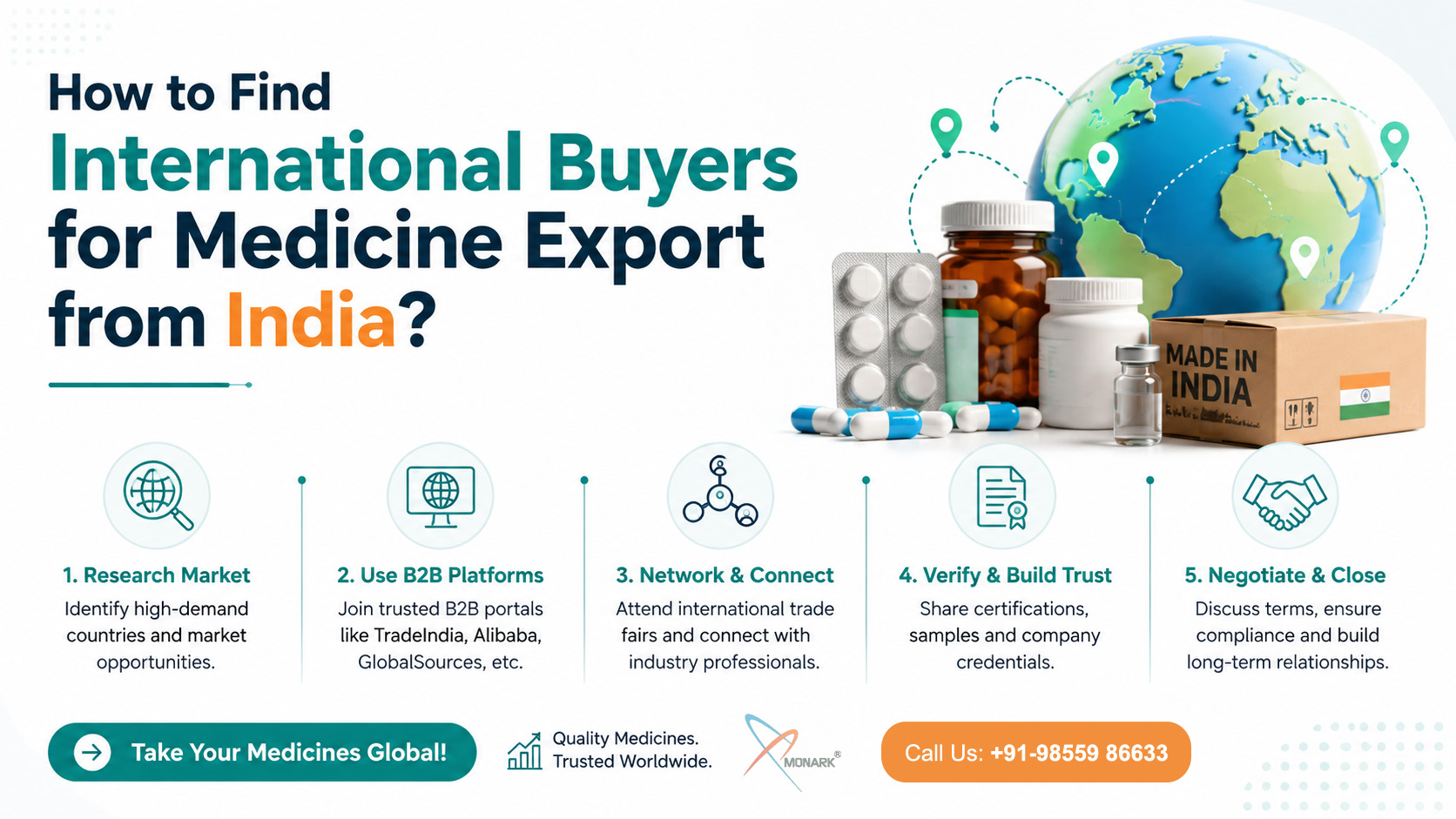
Indian pharmaceutical exporters can find international buyers by targeting suitable countries, identifying pharmaceutical importers and distributors, using trade and shipment data, attending pharma exhibitions, leveraging B2B platforms, and conducting personalized buyer outreach. The process should end with buyer verification and a clear product proposal.
The Real Problem: Indian Pharma Companies Have Products, But Where Are the Buyers?
A strong product portfolio is only one part of international business. Overseas buyers also look for dependable supply, appropriate documentation, competitive commercial terms, product quality, packaging options, and responsive communication.
For an Indian pharmaceutical exporter, the challenge is therefore not simply:
“Where can I find buyers?”
It is:
“Where can I find buyers who actually need my products and are capable of importing them?”
That small difference can completely change your export strategy.
Instead of collecting random email addresses, focus on creating a list of qualified prospects. These may include pharmaceutical importers, distributors, wholesalers, pharmacy chains, hospital suppliers, procurement companies, and businesses interested in private-label products.
Read also - Where Does India Export Medicines? Top Global Markets Revealed
India's Pharmaceutical Export Market: Verified Data You Should Know
Before searching for overseas buyers, it helps to understand the scale of India's pharmaceutical export market. According to the Government of India, India's pharmaceutical exports reached approximately US$30.47 billion in FY 2024–25, up about 9.4% from the previous financial year. India exported pharmaceutical products to 191 countries, demonstrating the industry's broad international reach.
The data also shows the importance of formulations and biological products, which accounted for approximately US$22.93 billion of India's pharmaceutical exports during FY 2024–25. For exporters, this highlights the potential available across finished pharmaceutical formulations and reinforces the importance of identifying suitable international distributors, importers, and healthcare businesses.
|
Verified Indicator |
FY 2024–25 Data |
|
Pharmaceutical exports from India |
US$30.47 billion |
|
Annual export growth |
9.4% |
|
Export destinations |
191 countries |
|
Drug Formulations & Biologicals |
US$22.93 billion |
|
Share of total pharmaceutical exports |
Approximately 75% |
These figures do not mean every product or company has equal export potential. Market demand, product registration, local regulations, competition, pricing, and buyer requirements still need to be evaluated individually. However, the overall export data confirms that India has a substantial international pharmaceutical trade base.
Source: Government of India, Ministry of Commerce & Industry / Press Information Bureau, pharmaceutical export data for FY 2024–25.
Start With the Buyer, Not the Product
Many exporters begin with a catalogue and then search for anyone willing to buy it.
A better approach is to start with the buyer.
Ask yourself:
-
Which countries have demand for my product categories?
-
Who imports similar medicines?
-
Which distributors work with these products?
-
What pack sizes and strengths are preferred?
-
What regulatory requirements apply?
-
What order quantities are commercially practical?
This buyer-first approach allows you to build a more relevant export strategy.
Who Could Actually Buy Your Medicines?
Depending on your portfolio, your prospects may include:
-
Pharmaceutical importers
-
Medicine distributors
-
Pharmaceutical wholesalers
-
Pharmacy chains
-
Hospital suppliers
-
Healthcare distributors
-
Government procurement companies
-
Generic medicine importers
-
Private-label pharmaceutical companies
The ideal buyer depends on your product, target market, regulatory position, and business model.
Pick a Market Before You Start Sending Emails
Trying to sell medicines to every country at once can quickly become expensive and inefficient.
Start by selecting two or three markets that appear commercially suitable for your products. Research demand, competition, existing imports, pricing, distribution networks, and regulatory requirements before starting outreach.
Look at These 5 Things First
1. Product demand: Is there a market for your therapeutic categories?
2. Existing imports: Are similar pharmaceutical products already being imported?
3. Competition: Which suppliers are already serving the market?
4. Regulatory requirements: Can your products meet the applicable requirements?
5. Distribution opportunities: Are reliable importers and distributors available?
For example, businesses researching medicine export from India should not assume that one product strategy will work equally well in every country.
Your objective is to find a market where your product portfolio and manufacturing capabilities have a realistic opportunity.
Your Next Lead Could Already Be Importing From India
One of the smartest ways to find international medicine buyers is to investigate companies that already import pharmaceutical products.
Import-export and shipment databases can provide valuable clues about companies involved in international trade. Instead of asking who might purchase your medicines, you can research companies that have demonstrated actual buying activity.
What Should You Look for in Trade Data?
Depending on the database, useful information may include:
-
Importer name
-
Product description
-
Country of destination
-
Supplier information
-
Shipment frequency
-
Product category
-
Trading history
-
Approximate shipment volume
Suppose a distributor has regularly imported a pharmaceutical category similar to yours. That company may deserve greater attention than a random business found through a general online search.
Trade data does not guarantee that a company is a suitable or trustworthy buyer, so always conduct additional due diligence before entering into a commercial relationship.
Don't Build a Huge Buyer List; Build a Qualified One
A database containing 5,000 contacts may look impressive, but it is not necessarily useful.
A smaller list of 50 well-researched prospects can be far more valuable if those businesses genuinely import or distribute pharmaceutical products.
A Good Pharmaceutical Buyer Should Pass These Checks
Before investing significant time in a prospect, consider checking:
-
Company registration and legal identity
-
Official website
-
Physical business address
-
Corporate email
-
Import authorization where applicable
-
Pharmaceutical distribution credentials
-
Existing market presence
-
Product sourcing history
-
Payment arrangements
-
Specific product requirements
This is especially important when searching for verified pharmaceutical buyers.
A serious prospect should generally be able to explain its business, target market, product requirements, approximate quantities, and relevant regulatory expectations.
Where International Pharmaceutical Buyers Actually Search for Suppliers
International buyers can discover Indian suppliers through several channels. Using multiple channels gives your business a stronger chance of being discovered.
1. B2B Marketplaces
B2B platforms can connect exporters with importers, distributors, wholesalers, and other businesses searching for pharmaceutical suppliers.
Create a detailed company profile and naturally use relevant phrases such as pharmaceutical products for export, pharmaceutical tablets from India, and Indian pharmaceutical exporters.
2. Google Search
Google can help identify pharmaceutical distributors and importers in specific countries.
Try searches such as:
“pharmaceutical importer in [country]”
“medicine distributor in [country]”
“generic medicine wholesaler in [country]”
The more specific your search, the more relevant your prospects are likely to be.
3. LinkedIn
LinkedIn can be useful for identifying decision-makers working at pharmaceutical importing and distribution companies.
Search for roles such as:
-
Procurement Manager
-
Purchase Manager
-
Import Manager
-
Pharmaceutical Distributor
-
Business Development Manager
-
Sourcing Manager
The goal is to start a professional conversation rather than immediately push a catalogue.
4. Pharmaceutical Trade Exhibitions
Trade exhibitions allow you to meet potential buyers directly, understand their requirements, and build relationships faster than traditional cold outreach.
Research exhibitors before the event and contact relevant companies in advance.
5. Import-Export Databases
Trade databases can help you identify businesses with actual international sourcing activity.
6. Buyer-Seller Meets
Government and industry-organized buyer-seller meetings can provide opportunities to meet international companies looking for suppliers.
7. Referrals and Existing Networks
Never underestimate existing business relationships. A distributor, manufacturer, consultant, or industry contact may introduce you to a potential buyer.
Your Website Should Answer the Buyer's First 7 Questions
Your website often becomes the second step after a buyer receives your email.
Before replying, an international prospect may visit your website to determine whether your company appears legitimate and capable.
Your website should clearly answer:
-
Who are you?
-
What do you manufacture?
-
Which products do you offer?
-
Can you supply internationally?
-
What quality and manufacturing capabilities do you have?
-
Do you offer manufacturing partnerships?
-
How can the buyer contact you?
If your website promotes pharmaceutical tablets from India, buyers should be able to reach the relevant product category easily.
A clean product portfolio, clear company information, useful content, and accessible contact details can make your business appear considerably more professional.
What Should an International Buyer See Before Saying “Yes”?
A buyer does not want to spend hours requesting basic information.
Prepare a professional supplier package that can be adapted to each prospect.
Product Information
Provide relevant details such as composition, strength, dosage form, packaging, and product category.
Manufacturing Capability
Explain what your company can manufacture and whether you can support the required quantities.
Quality & Documentation
Share applicable quality and regulatory information when requested.
Packaging Options
Explain available pack formats and whether customized packaging can be discussed.
MOQ & Lead Time
Clearly communicate minimum order quantities and expected manufacturing timelines where applicable.
Commercial Terms
Provide a clear quotation based on the buyer's specific requirements rather than sending a generic price list without context.
Stop Sending the Same Catalogue to Every Buyer
Imagine that a buyer contacts you looking specifically for pharmaceutical tablets.
Sending them a catalogue containing hundreds of unrelated products can make the conversation harder.
Instead, identify what they are looking for and send a focused selection.
For example:
“Based on your interest in tablet formulations, we have selected the following products from our portfolio for your review.”
This small change can make your communication feel more professional.
The same principle applies to pharmaceutical products for export in general. Match the proposal to the buyer instead of forcing the buyer to search through your entire portfolio.
The First Email Should Start a Conversation, Not Make a Sale
Your first message does not need to contain every detail about your company.
Keep it short and relevant.
A good introduction can include:
Company: Who you are.
Capability: What pharmaceutical products you manufacture or supply.
Reason for contact: Why you believe the buyer may be relevant.
Product: Which category you want to discuss.
Next step: Ask whether they have a current sourcing requirement.
The goal is to earn a response.
Once the buyer responds, you can discuss product specifications, documentation, pricing, packaging, quantities, and other commercial details.
No Reply? Here's How to Follow Up Without Looking Desperate
No response does not always mean no interest.
Your email could have been overlooked, the buyer may be busy, or the company may not currently be purchasing.
A simple follow-up process can help.
Follow-Up 1: Check In
Ask whether the buyer had an opportunity to review your introduction.
Follow-Up 2: Add Relevance
Share a small selection of products that may fit the buyer's market.
Follow-Up 3: Ask About Timing
Ask whether the company has an upcoming sourcing requirement.
Keep your messages short and professional. Avoid sending the same message repeatedly.
International Buyers Want More Than Low Prices
Price is important, but it is rarely the only factor in pharmaceutical sourcing.
A buyer also wants confidence that the supplier can deliver consistently.
The strongest Indian pharmaceutical suppliers can differentiate themselves through:
-
Consistent product quality
-
Reliable manufacturing
-
Competitive pricing
-
Appropriate documentation
-
Stable supply
-
Suitable packaging
-
Clear communication
-
Timely responses
When competing with other Indian pharmaceutical exporters, simply offering a lower price may not create a sustainable advantage.
Reliability can be much more valuable.
Don't Have Your Own Manufacturing Facility? There Is Another Route
International business opportunities are not limited to selling finished products under your own manufacturing setup.
Some companies already have brands, distributors, or market access but need an Indian manufacturer capable of producing their required formulations.
This is where pharmaceutical third-party manufacturing can become relevant.
A suitable manufacturing partnership may involve discussions around:
-
Product formulation
-
Manufacturing quantities
-
Packaging
-
Brand requirements
-
Quality expectations
-
Product portfolio
-
Commercial terms
For companies searching for a manufacturing partner, pharmaceutical third-party manufacturing can be an alternative route to building a pharmaceutical business without establishing an independent manufacturing facility.
More Than Export: Explore Different Pharma Partnership Models
Finding overseas buyers is only one part of pharmaceutical business development.
Depending on your objectives, you may also explore:
-
PCD Pharma Franchise
-
Third-party manufacturing
-
Contract manufacturing
-
Private-label manufacturing
-
Institutional supply
-
Pharmaceutical distribution
-
Export partnerships
These pharma business opportunities in India can suit different types of businesses.
For example, an established distributor may want finished medicines, while another healthcare company may be interested in developing its own brand through a manufacturing partner.
Understanding the difference allows you to present a more suitable business proposal.
Your 30-Day Plan to Start Finding International Buyers
Instead of trying every buyer-finding method at once, follow a focused 30-day approach. The goal is to research the right markets, build a qualified prospect list, begin personalized outreach, and move promising leads toward genuine business discussions.
|
Timeline |
Main Objective |
Key Actions |
|
Week 1 – Research & Market Selection |
Find the right markets and buyer segments |
Select 2–3 potential countries; identify products with market potential; research competitors; study import requirements; identify relevant buyer categories |
|
Week 2 – Build Your Buyer List |
Create a qualified prospect database |
Find pharmaceutical importers and distributors; research shipment data; check company websites; identify decision-makers; verify potential prospects |
|
Week 3 – Start Buyer Outreach |
Begin meaningful conversations |
Send personalized emails; connect with relevant decision-makers; share focused product information; introduce your manufacturing capabilities |
|
Week 4 – Convert Qualified Leads |
Move prospects toward business discussions |
Follow up with interested buyers; answer product questions; discuss quantities and packaging; prepare quotations; review regulatory requirements; move qualified leads toward negotiation |
Key takeaway: Consistency is more important than sending hundreds of messages in a single week. A smaller number of well-researched and professionally approached prospects can deliver better results than a large database of unqualified contacts.
Why Consider Monark Biocare for Your Pharmaceutical Requirements?
Once you identify a potential international buyer, the next question is where the products will come from.
A dependable Indian manufacturing partner can help support your supply requirements and make your international business strategy more practical.
Monark Biocare offers a pharmaceutical product portfolio covering multiple dosage forms and supports different pharmaceutical business models.
If you are specifically looking for pharmaceutical tablets from India, you can explore the pharmaceutical tablets portfolio to review the available product range.
For businesses searching for pharmaceutical products for export, the appropriate product and manufacturing requirements can be discussed based on the target market and buyer's needs.
Companies interested in manufacturing partnerships can also explore pharmaceutical third-party manufacturing.
If you want to contact a pharmaceutical manufacturer in India, you can connect with Monark Biocare to discuss your product, manufacturing, packaging, and business requirements.
The Bottom Line: Find Fewer Buyers, But Better Buyers
Successful medicine export from India is not about collecting thousands of international contacts.
It is about finding companies that actually import, distribute, or source pharmaceutical products and then giving those companies a clear reason to consider your business.
Start with the right market. Research actual importers. Use trade data intelligently. Build a qualified prospect list. Verify potential buyers. Personalize your outreach. Provide relevant product information and follow up professionally.
Most importantly, focus on relationships rather than one-time transactions.
A genuine international buyer can become a long-term distribution partner, while a reliable Indian manufacturer can become a consistent part of that buyer's supply chain.
If you are exploring pharmaceutical products for export, pharmaceutical tablets from India, pharmaceutical third-party manufacturing, or other pharma business opportunities in India, the right partnership can help turn an initial enquiry into a sustainable business relationship.
Your Next International Pharma Opportunity Starts Here
Finding the right buyer is only the beginning. Once you have identified an importer, distributor, or healthcare company, the next step is to connect that opportunity with the right pharmaceutical solution.
One Partner. Multiple Pharma Business Routes.
|
If You Need… |
Explore With Monark Biocare |
|
🔹 Medicines for overseas markets |
|
|
🔹 A reliable manufacturing partner |
|
|
🔹 Pharmaceutical business expansion |
|
|
🔹 Professional product promotion |
|
|
🔹 Broader pharmaceutical business support |
Why Stop at a Buyer Enquiry?
A successful export relationship can develop into a long-term supply, manufacturing, distribution, or brand partnership. Whether you need pharmaceutical products for export, manufacturing support, ethical promotion, or a PCD business opportunity, the right model depends on your market and business goals.
Monark Biocare
➜ Plot No. 201, HSIIDC, Alipur, Barwala, Haryana, India
➜ monarkbiocare@gmail.com
➜ +91-9855986633 | +91-9023256719 | +91-9888656719
Talk to Monark Biocare About Your Pharma Requirement
Frequently Asked Questions About Medicine Export from India
Q1. What is the fastest way to find international medicine buyers?
There is no single fastest method for every exporter. Import-export data, pharmaceutical distributors, B2B platforms, trade exhibitions, LinkedIn, and direct outreach can all generate buyer leads. The best results usually come from combining several channels.
Q2. Which international buyers should Indian pharmaceutical exporters target?
Focus on pharmaceutical importers, distributors, wholesalers, pharmacy chains, hospital suppliers, and healthcare companies that already handle products similar to yours. Matching the buyer's requirements with your product portfolio can improve the quality of your leads.
Q3. How do I know whether a pharmaceutical buyer is genuine?
Before negotiating an order, review the company's business registration, website, physical address, import or distribution credentials, sourcing history, and product requirements. Avoid relying only on an email address or online enquiry as proof of legitimacy.
Q4. What information should I send to an overseas medicine buyer?
Start with a focused company profile, relevant product list, composition, dosage form, packaging, manufacturing information, applicable documentation, MOQ, lead time, and commercial terms. Tailoring the information to the buyer is generally more effective than sending an unrelated large catalogue.
Q5. Can I export pharmaceutical tablets from India to international markets?
Indian pharmaceutical companies can supply various formulations, including pharmaceutical tablets from India, subject to applicable export and destination-country requirements. Product registration, documentation, labelling, and import regulations can differ between countries and products.
Q6. Can Monark Biocare support international pharmaceutical business requirements?
Businesses can approach Monark Biocare to discuss pharmaceutical product sourcing, manufacturing, third-party manufacturing, and potential export-related requirements. Specific opportunities depend on the product, target market, regulatory requirements, quantities, and commercial terms.
Disclaimer
The information provided in this article about medicine export from India, international pharmaceutical buyers, export processes, regulations, and business opportunities is intended for general informational purposes only. Requirements may vary depending on the product, destination country, regulatory authority, and applicable laws. Readers should independently verify current regulatory, legal, commercial, and import requirements before proceeding. Monark Biocare does not guarantee buyer availability, export approval, market access, or business results based solely on the information provided in this article.